







Question: 4 points) For a D-type flip-flop: A. The present state is the value of Q and the next state will be whatever the input value
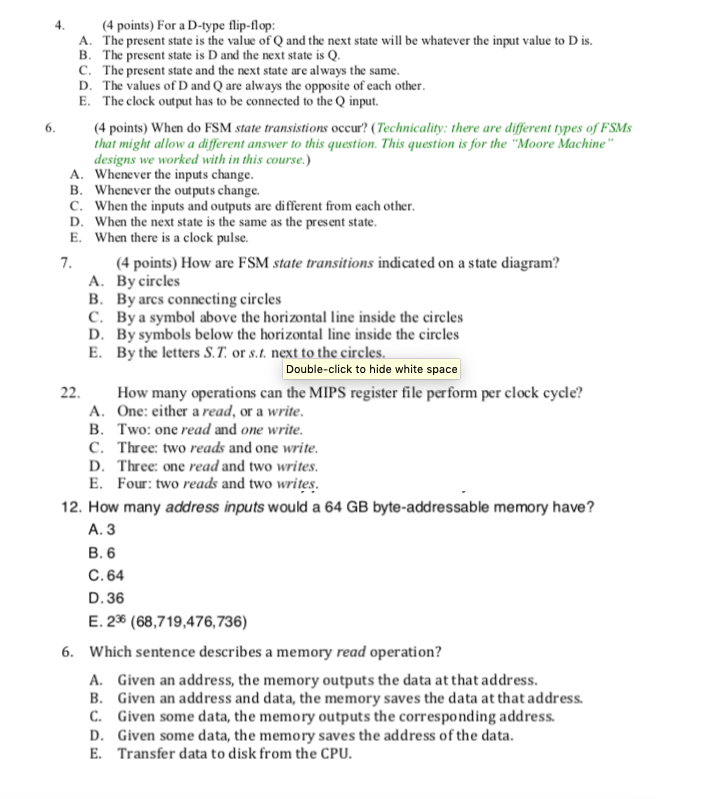
4 points) For a D-type flip-flop: A. The present state is the value of Q and the next state will be whatever the input value to D is. B. The present state is D and the next state is Q C. The present state and the next state are always the same D. The values of D and Q are always the opposite of each other E. The clock output has to be connected to the Q input. A. B. C. D. E. 4 points) When do FSM state transistions occur? (Technicality: there are different types of FSMs that might allow a different answer to this question. This question is for the Moore Machine" designs we worked with in this course.) Whenever the inputs change Whenever the outputs change. When the inputs and outputs are different from each other When the next state is the same as the present state When there is a clock pulse. 7. 4 points) How are FSM state transitions indicated on a state diagram? A. By circles B. By ares connecting circles C. By a symbol above the horizontal line inside the circles D. By symbols below the horizontal line inside the circles E. By the letters S.T.or s.t next to the circles Double-click to hide white space A. B. C. D. E. How many operations can the MIPS register file perform per clock cycle? One: either a read, or a write Two: one read and one write Three: two reads and one write Three: one read and two writes Four: two reads and two writes 12. How many address inputs would a 64 GB byte-addressable memory have? A. 3 B. 6 C. 64 D. 36 E. 23 (68,719,476,736) Which sentence describes a memory read operation? 6. A. Given an address, the memory outputs the data at that address. B. Given an address and data, the memory saves the data at that address C. Given some data, the memory outputs the corresponding address. D. Given some data, the memory saves the address of the data. E. Transfer data to disk from the CPU
Step by Step Solution
There are 3 Steps involved in it

Get step-by-step solutions from verified subject matter experts
 Study Help