



Question: 4. Problem 3.08 (Personal Taxes) eBook Problem Walk-Through Susan and Stan Britton are a married couple who file a joint income tax return, where the
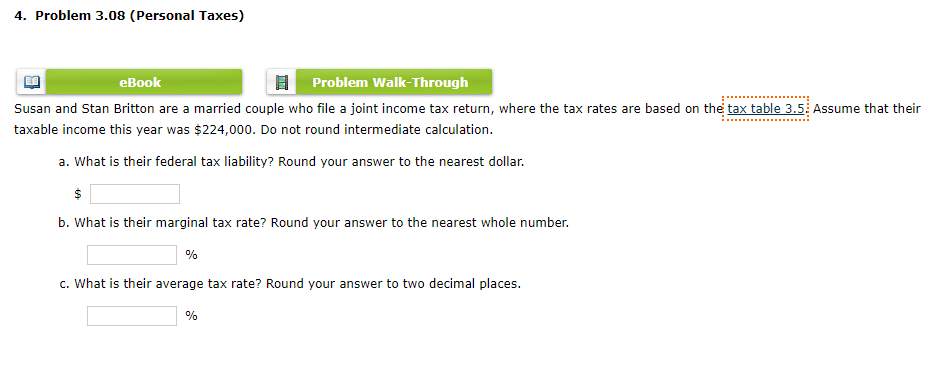
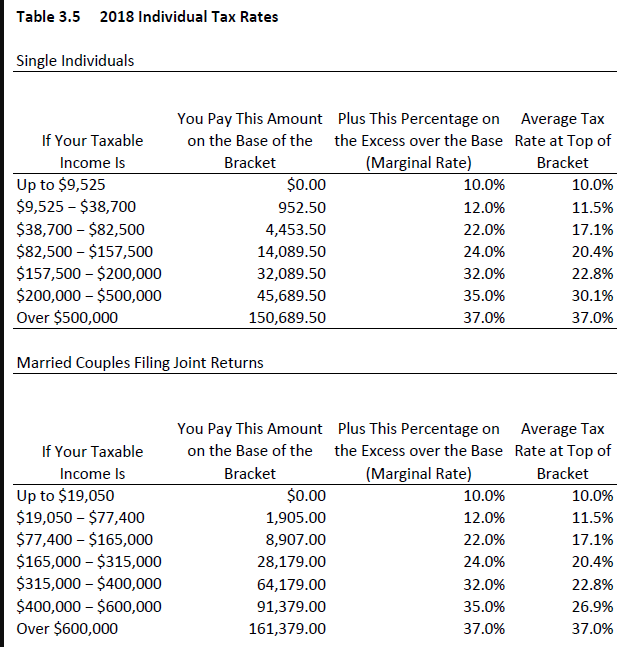
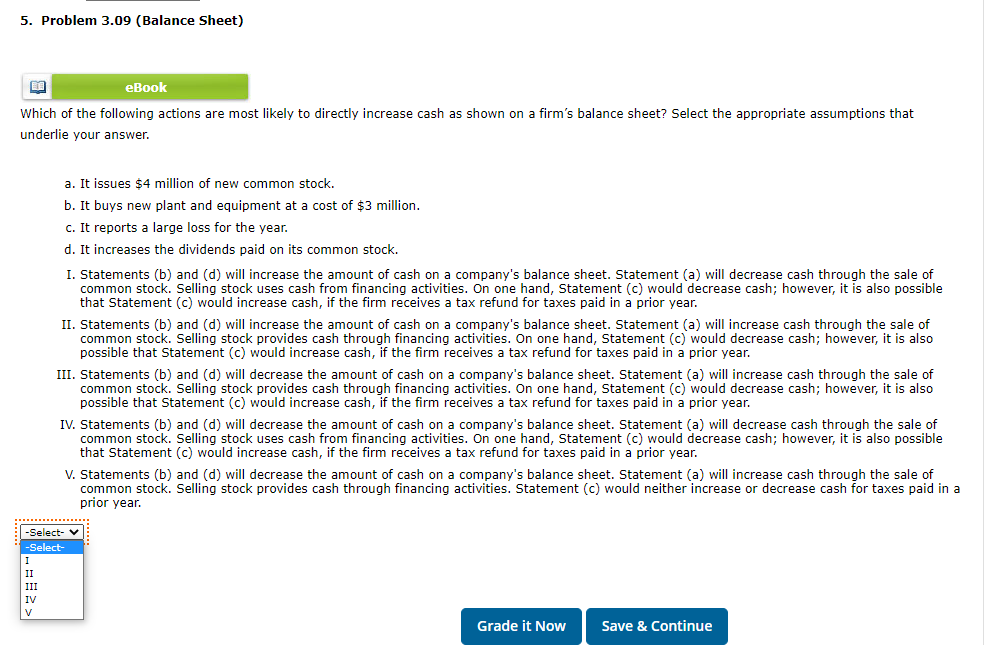
4. Problem 3.08 (Personal Taxes) eBook Problem Walk-Through Susan and Stan Britton are a married couple who file a joint income tax return, where the tax rates are based on the tax table 3.5. Assume that their taxable income this year was $224,000. Do not round intermediate calculation. a. What is their federal tax liability? Round your answer to the nearest dollar. $ b. What is their marginal tax rate? Round your answer to the nearest whole number. % c. What is their average tax rate? Round your answer to two decimal places. % Table 3.5 2018 Individual Tax Rates Single Individuals If Your Taxable Income Is Up to $9,525 $9,525 - $38,700 $38,700 - $82,500 $82,500 - $157,500 $157,500 - $200,000 $200,000 - $500,000 Over $500,000 You Pay This Amount Plus This Percentage on Average Tax on the base of the the Excess over the Base Rate at Top of Bracket (Marginal Rate) Bracket $0.00 10.0% 10.0% 952.50 12.0% 11.5% 4,453.50 22.0% 17.1% 14,089.50 24.0% 20.4% 32,089.50 32.0% 22.8% 45,689.50 35.0% 30.1% 150,689.50 37.0% 37.0% Married couples Filing Joint Returns If Your Taxable Income Is Up to $19,050 $19,050 - $77,400 $77,400 - $165,000 $165,000 - $315,000 $315,000 - $400,000 $400,000 - $600,000 Over $600,000 You Pay This Amount Plus This Percentage on Average Tax on the Base of the the Excess over the Base Rate at Top of Bracket (Marginal Rate) Bracket $0.00 10.0% 10.0% 1,905.00 12.0% 11.5% 8,907.00 22.0% 17.1% 28,179.00 24.0% 20.4% 64,179.00 32.0% 22.8% 91,379.00 35.0% 26.9% 161,379.00 37.0% 37.0% 5. Problem 3.09 (Balance Sheet) ER eBook Which of the following actions are most likely to directly increase cash as shown on underlie your answer. firm's balance sheet? Select the appropriate assumptions that a. It issues $4 million of new common stock. b. It buys new plant and equipment at a cost of $3 million. c. It reports a large loss for the year. d. It increases the dividends paid on its common stock. I. Statements (b) and (d) will increase the amount of cash on a company's balance sheet. Statement (a) will decrease cash through the sale of common stock. Selling stock uses cash from financing activities. On one hand, Statement (c) would decrease cash; however, it is also possible that Statement (c) would increase cash, if the firm receives a tax refund for taxes paid in a prior year. II. Statements (b) and (d) will increase the amount of cash on a company's balance sheet. Statement (a) will increase cash through the sale of common stock. Selling stock provides cash through financing activities. On one hand, Statement (c) would decrease cash; however, it is also possible that Statement (c) would increase cash, if the firm receives a tax refund for taxes paid in a prior year. III. Statements (b) and (d) will decrease the amount of cash on a company's balance sheet. Statement (a) will increase cash through the sale of common stock. Selling stock provides cash through financing activities. On one hand, Statement (c) would decrease cash; however, it is also possible that Statement (c) would increase cash, if the firm receives a tax refund for taxes paid in a prior year. IV. Statements (b) and (d) will decrease the amount of cash on a company's balance sheet. Statement (a) will decrease cash through the sale of common stock. Selling stock uses cash from financing activities. On one hand, Statement (c) would decrease cash; however, it is also possible that Statement (C) would increase cash, if the firm receives a tax refund for taxes paid in a prior year. V. Statements (b) and (d) will decrease the amount of cash on a company's balance sheet. Statement (a) will increase cash through the sale of common stock. Selling stock provides cash through financing activities. Statement (c) would neither increase or decrease cash for taxes paid in a prior year. -Select- -Select II III IV v Grade it Now Save & Continue
Step by Step Solution
There are 3 Steps involved in it

Get step-by-step solutions from verified subject matter experts