



Question: 4 Questions are in the third picture! your help will be greatly appreciate it! thank you WestJet is a fast-growing Canadian discount airline, headquartered in
4 Questions are in the third picture! your help will be greatly appreciate it! thank you 
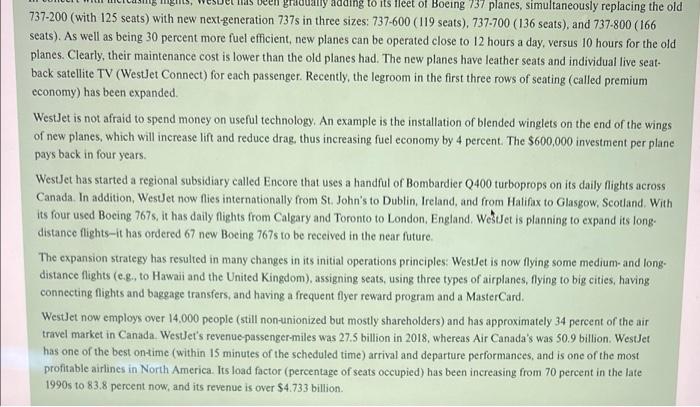

WestJet is a fast-growing Canadian discount airline, headquartered in Calgary. It started in 1996 with three used aircraft targeting short trips in Western Canada (between Calgary, Edmonton, Kelowna, Winnipeg, and Vancouver). Clive Beddoe, one of the founders of WestJet, got the idea for WestJet after having to pay exorbitant fares to Air Canada for his frequent flights between Calgary (his hometown) and Edmonton and Vancouver, where he owned plastic manufacturing plants. According to Beddoe, "The key to expanding the market and luring masses of people who don't travel and those who drive is to charge them bargain-basement fares." He called this market the visiting friends and relatives" market. In order to be able to offer low prices, WestJet needed to run low-cost operations. WestJet studied successful discount airlines in the United States such as Southwest Airlines, and copied most of their operations principles Page 53 How could WestJet have planned for an operating cost per available seat mile approximately half that of Air Canada? The main principles of WestJet's plan were: Short-distance flights Single class of passengers (no first or business class), No seat assignment Use only one type of airplane: Boeing 737. Fly to smaller cities Recruit young, enthusiastic employees whose salary is slightly lower than the industry average, but who receive profit-sharing bonuses and can participate in an employce share-purchase program Emphasize a "fun and friendly culture and empower the employees Use equity financing and tight financial controls. Use paperless tickets (WestJet was the first airline in North America to do so). . . las been gradually adding to its lleet of Boeing 737 planes, simultaneously replacing the old 737-200 (with 125 seats) with new next-generation 737s in three sizes: 737-600 (119 seats). 737-700 (136 seats)and 737-800 (166 seats). As well as being 30 percent more fuel efficient, new planes can be operated close to 12 hours a day, versus 10 hours for the old planes. Clearly, their maintenance cost is lower than the old planes had. The new planes have leather seats and individual live seat- back satellite TV (WestJet Connect) for each passenger. Recently, the legroom in the first three rows of seating (called premium economy) has been expanded. WestJet is not afraid to spend money on useful technology. An example is the installation of blended winglets on the end of the wings of new planes, which will increase lift and reduce drag, thus increasing fuel economy by 4 percent. The $600,000 investment per plane pays back in four years WestJet has started a regional subsidiary called Encore that uses a handful of Bombardier Q400 turboprops on its daily flights across Canada. In addition, WestJet now flies internationally from St. John's to Dublin, Ireland, and from Halifax to Glasgow, Scotland. With its four used Boeing 767s, it has daily flights from Calgary and Toronto to London, England. Weitet is planning to expand its long- distance flights-it has ordered 67 new Boeing 767s to be received in the near future, The expansion strategy has resulted in many changes in its initial operations principles: WestJet is now flying some medium- and long- distance flights (e.g., to Hawaii and the United Kingdom), assigning seats, using three types of airplanes, flying to big cities, having connecting flights and baggage transfers, and having a frequent flyer reward program and a MasterCard, WestJet now employs over 14,000 people (still non-unionized but mostly shareholders) and has approximately 34 percent of the air travel market in Canada WestJet's revenue passenger-miles was 27.5 billion in 2018, whereas Air Canada's was $0.9 billion. WestJet has one of the best on-time (within 15 minutes of the scheduled time) arrival and departure performances, and is one of the most profitable airlines in North America. Its load factor (percentage of seats occupied) has been increasing from 70 percent in the late 1990s to 83.8 percent now, and its revenue is over $4.733 billion Questions 1. What market segment did WestJet originally compete in? 2. What competitive priority did WestJet originally have? 3. What were the advantages of each of the initial principles used by WestJet in 1996 to reduce its operating costs? 4. How has WestJet kept its operating costs low while growing
Step by Step Solution
There are 3 Steps involved in it
1 Expert Approved Answer
Step: 1 Unlock

Question Has Been Solved by an Expert!
Get step-by-step solutions from verified subject matter experts
Step: 2 Unlock
Step: 3 Unlock