







Question: 4. The standard addition method is used in analyses when (A) better precision is needed. (B) the calibration curve is not linear. (C) the concentrations
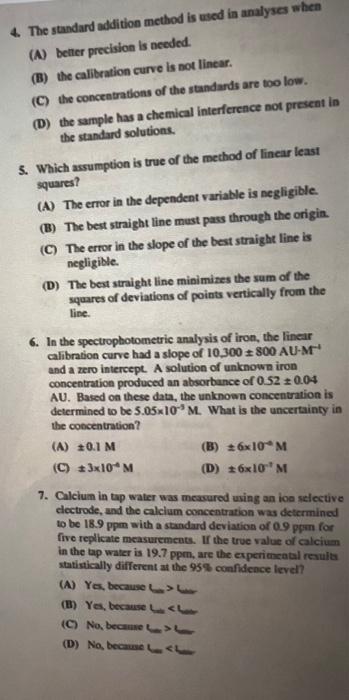
4. The standard addition method is used in analyses when (A) better precision is needed. (B) the calibration curve is not linear. (C) the concentrations of the standards are too low. (D) the sample has a chemical interfcrence not present in the standard solutions. 5. Which assumption is true of the method of linear least squares? (A) The error in the dependent variable is negligible. (B) The best straight line must pass through the origin. (C) The error in the slope of the best straight line is negligible. (D) The best straight line minimixes the sum of the squares of deviations of points vertically from the line. 6. In the spectrophotometric analysis of iron, the linear calibration curve had a slope of 10,300800AUM1 and a zero intercept. A solution of unknown iron concentration produced an absorbance of 0.520.04 AU. Based on these data, the unknown concentration is determined to be 5.05103M. What is the uncertainty in the concentration? (A) 0.1M (B) =6104M (C) 3104M (D) 6107M 7. Calcium in tap water was messured uxing an ioe selective electrode, and the calcium concentration was determined to be I8.9 ppm with a standard deviation of 0.9ppm for five replicate measurements. If the true value of calcium in the tap water is 19.7ppm, are the experiuseatal reaula statistically different at the 95% confidence leveh? (A) Ya, because 4>L (B) Ya, because L 44 (D) Na becaue 4
Step by Step Solution
There are 3 Steps involved in it

Get step-by-step solutions from verified subject matter experts
 Study Help