







Question: 46. Tammy loves doughnuts. The table shown reflects the value Tammy places on each doughnut she eats: 47. 48. 49. 50. alue of first doughnut
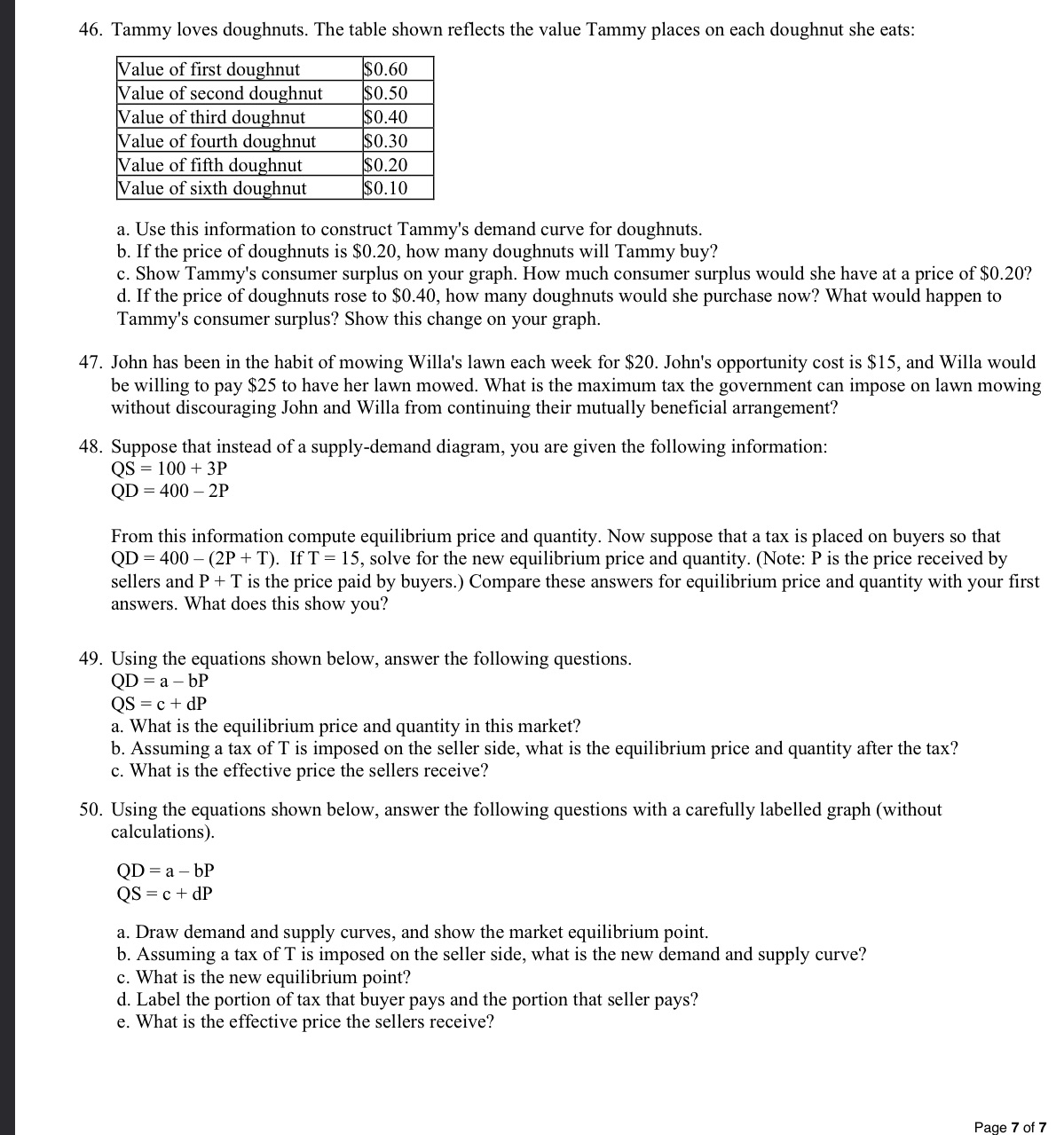
46. Tammy loves doughnuts. The table shown reflects the value Tammy places on each doughnut she eats: 47. 48. 49. 50. alue of first doughnut 50.60 | alue of second doughnut 50.50 alue of third doughnut 50.40 alue of fourth doughnut 50.30 alue of fifth doughnut $0.20 alue of sixth doughnut $0.10 | a. Use this information to construct Tammy's demand curve for doughnuts. b. If the price of doughnuts is $0.20, how many doughnuts will Tammy buy? . Show Tammy's consumer surplus on your graph. How much consumer surplus would she have at a price of $0.20? d. If the price of doughnuts rose to $0.40, how many doughnuts would she purchase now? What would happen to Tammy's consumer surplus? Show this change on your graph. John has been in the habit of mowing Willa's lawn each week for $20. John's opportunity cost is $15, and Willa would be willing to pay $25 to have her lawn mowed. What is the maximum tax the government can impose on lawn mowing without discouraging John and Willa from continuing their mutually beneficial arrangement? Suppose that instead of a supply-demand diagram, you are given the following information: QS =100+ 3P QD =400 -2P From this information compute equilibrium price and quantity. Now suppose that a tax is placed on buyers so that QD =400- 2P+ T). If T = 15, solve for the new equilibrium price and quantity. (Note: P is the price received by sellers and P + T is the price paid by buyers.) Compare these answers for equilibrium price and quantity with your first answers. What does this show you? Using the equations shown below, answer the following questions. QD =a-bP QS=c+dP a. What is the equilibrium price and quantity in this market? b. Assuming a tax of T is imposed on the seller side, what is the equilibrium price and quantity after the tax? c. What is the effective price the sellers receive? Using the equations shown below, answer the following questions with a carefully labelled graph (without calculations). QD=2 bP QS=c+dP a. Draw demand and supply curves, and show the market equilibrium point. b. Assuming a tax of T is imposed on the seller side, what is the new demand and supply curve? c. What is the new equilibrium point? d. Label the portion of tax that buyer pays and the portion that seller pays? e. What is the effective price the sellers receive? Page 7of 7
Step by Step Solution
There are 3 Steps involved in it

Get step-by-step solutions from verified subject matter experts
 Study Help