



Question: 471 A particle starts from rest with acceleration a, which remains constant for Acc. an interval of t sec. At the beginning of the second
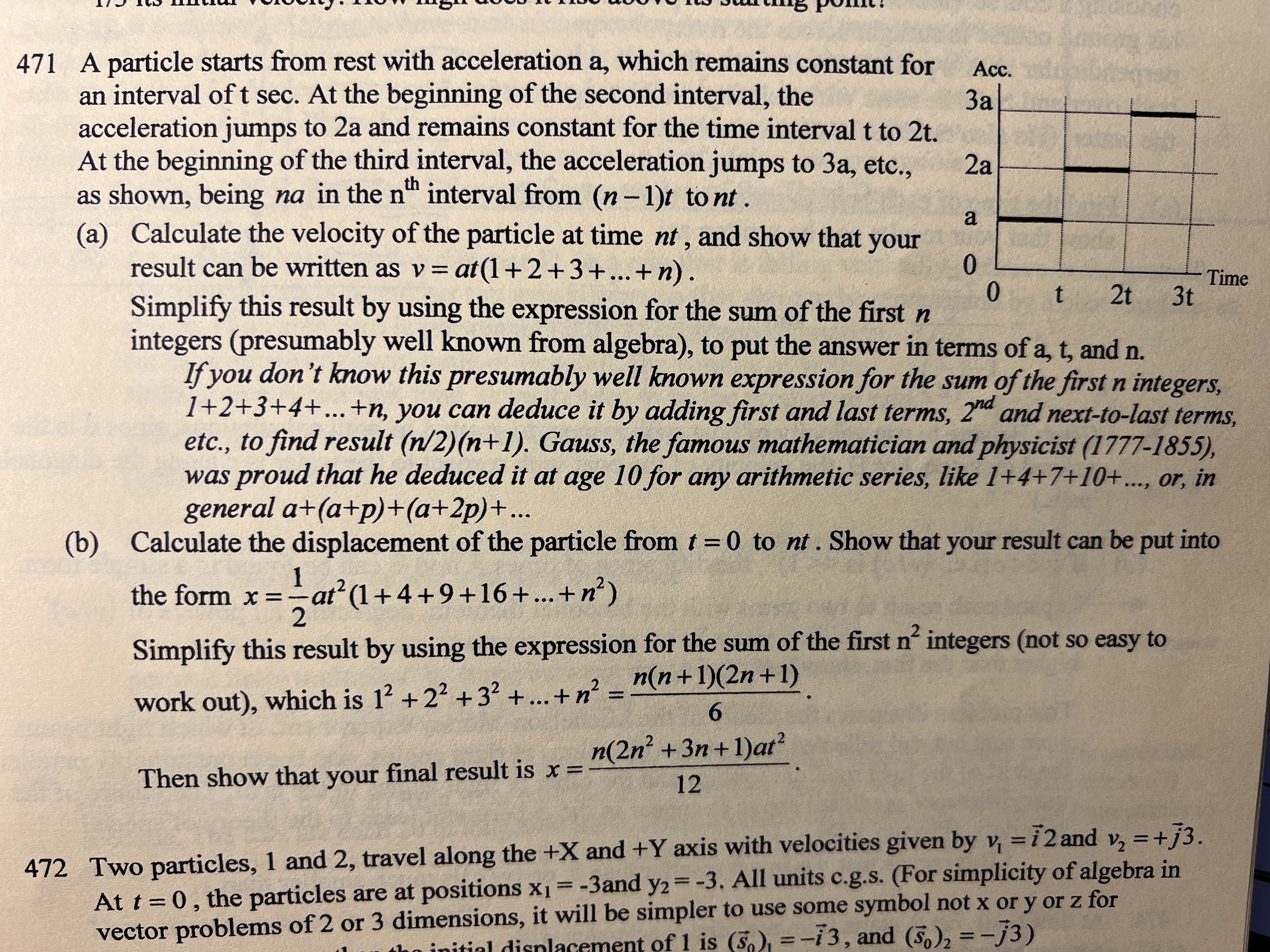
471 A particle starts from rest with acceleration a, which remains constant for Acc. an interval of t sec. At the beginning of the second interval, the acceleration jumps to 2a and remains constant for the time interval t to 2t. At the beginning of the third interval, the acceleration jumps to 3a, etc., as shown, being na in the n" interval from (n -1)t to nt . (a) Calculate the velocity of the particle at time nt , and show that your result can be written as v = at(1+ 2 + 3 + ... + n). O O t Time Simplify this result by using the expression for the sum of the first n integers (presumably well known from algebra), to put the answer in terms of a, t, and n. If you don't know this presumably well known expression for the sum of the first n integers, 1+2+3+4+... +n, you can deduce it by adding first and last terms, 2" and next-to-last terms, etc., to find result (n/2) (n+1). Gauss, the famous mathematician and physicist (1777-1855), was proud that he deduced it at age 10 for any arithmetic series, like 1+4+7+10+..., or, in general a+(atp) +(a+2p)+ ... (b) Calculate the displacement of the particle from t =0 to nt . Show that your result can be put into the form x = - at? (1 + 4 + 9 +16 + ... + n?) Simplify this result by using the expression for the sum of the first n' integers (not so easy to work out), which is 12 + 22 + 32 +... + n2 _ n(n+1)(2n+1) Then show that your final result is x - (2n- + 3n + 1)at2 472 Two particles, 1 and 2, travel along the +X and +Y axis with velocities given by v, = 12 and v, = +j3. At t = 0, the particles are at positions x1 = -3and y2 = -3. All units c.g.s. (For simplicity of algebra in vector problems of 2 or 3 dimensions, it will be simpler to use some symbol not x or y or z for t of 1 is (3 ), =-73, and (50 )2 =-j3)
Step by Step Solution
There are 3 Steps involved in it

Get step-by-step solutions from verified subject matter experts