







Question: 5) A communication system has been modeled as a DTMC alternating between two states: idle, and successfully transmitting. After a packet is successfully transmitted, the
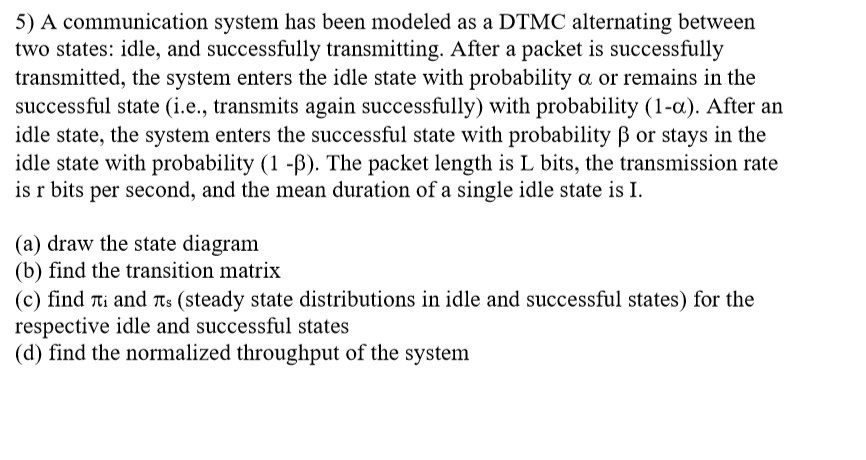
5) A communication system has been modeled as a DTMC alternating between two states: idle, and successfully transmitting. After a packet is successfully transmitted, the system enters the idle state with probability a or remains in the successful state (i.e., transmits again successfully) with probability (1-a). After an idle state, the system enters the successful state with probability B or stays in the idle state with probability (1-B). The packet length is L bits, the transmission rate is r bits per second, and the mean duration of a single idle state is I. (a) draw the state diagram (b) find the transition matrix (c) find Ti and its (steady state distributions in idle and successful states) for the respective idle and successful states (d) find the normalized throughput of the system 5) A communication system has been modeled as a DTMC alternating between two states: idle, and successfully transmitting. After a packet is successfully transmitted, the system enters the idle state with probability a or remains in the successful state (i.e., transmits again successfully) with probability (1-a). After an idle state, the system enters the successful state with probability B or stays in the idle state with probability (1-B). The packet length is L bits, the transmission rate is r bits per second, and the mean duration of a single idle state is I. (a) draw the state diagram (b) find the transition matrix (c) find Ti and its (steady state distributions in idle and successful states) for the respective idle and successful states (d) find the normalized throughput of the system
Step by Step Solution
There are 3 Steps involved in it

Get step-by-step solutions from verified subject matter experts
 Study Help