Question: 5. Consider the data below from Standard Spanish, and complete the activities that follow. All forms are transcribed according to standard IPA conventions. (1) [toldo]
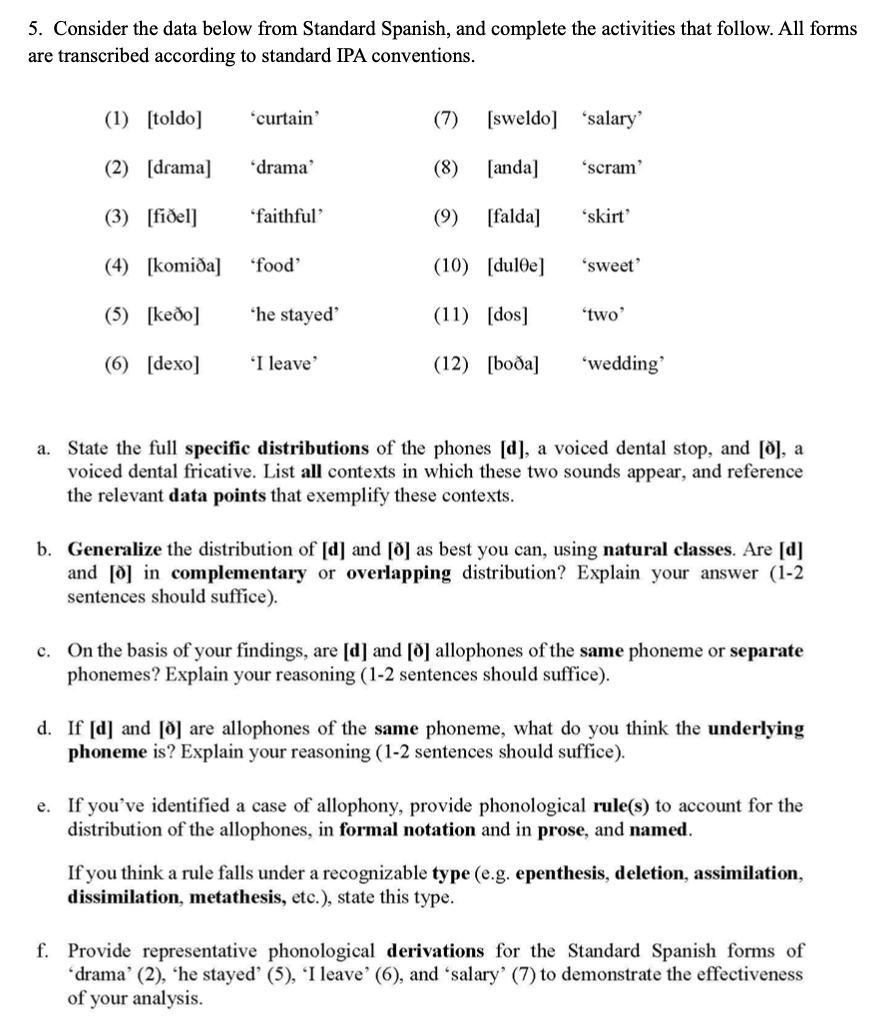
5. Consider the data below from Standard Spanish, and complete the activities that follow. All forms are transcribed according to standard IPA conventions. (1) [toldo] 'curtain (7) [sweldo] "salary (2) [drama] drama' (8) [anda] 'scram (3) [fiel] faithful (9) [falda] skirt' (4) [komia] 'food' (10) [dulde] sweet (5) [keo] he stayed (11) [dos] "two (6) [dexo] 'I leave (12) [boa] 'wedding a. State the full specific distributions of the phones [a], a voiced dental stop, and [], a voiced dental fricative. List all contexts in which these two sounds appear, and reference the relevant data points that exemplify these contexts. b. Generalize the distribution of [a] and [/] as best you can, using natural classes. Are [d] and [/] in complementary or overlapping distribution? Explain your answer (1-2 sentences should suffice). c. On the basis of your findings, are [d] and [/] allophones of the same phoneme or separate phonemes? Explain your reasoning (1-2 sentences should suffice). d. If [d] and [0] are allophones of the same phoneme, what do you think the underlying phoneme is? Explain your reasoning (1-2 sentences should suffice). e. If you've identified a case of allophony, provide phonological rule(s) to account for the distribution of the allophones, in formal notation and in prose, and named. If you think a rule falls under a recognizable type (e.g. epenthesis, deletion, assimilation, dissimilation, metathesis, etc.), state this type. f. Provide representative phonological derivations for the Standard Spanish forms of drama' (2), 'he stayed' (5), 'I leave' (6), and 'salary' (7) to demonstrate the effectiveness of your analysis. 5. Consider the data below from Standard Spanish, and complete the activities that follow. All forms are transcribed according to standard IPA conventions. (1) [toldo] 'curtain (7) [sweldo] "salary (2) [drama] drama' (8) [anda] 'scram (3) [fiel] faithful (9) [falda] skirt' (4) [komia] 'food' (10) [dulde] sweet (5) [keo] he stayed (11) [dos] "two (6) [dexo] 'I leave (12) [boa] 'wedding a. State the full specific distributions of the phones [a], a voiced dental stop, and [], a voiced dental fricative. List all contexts in which these two sounds appear, and reference the relevant data points that exemplify these contexts. b. Generalize the distribution of [a] and [/] as best you can, using natural classes. Are [d] and [/] in complementary or overlapping distribution? Explain your answer (1-2 sentences should suffice). c. On the basis of your findings, are [d] and [/] allophones of the same phoneme or separate phonemes? Explain your reasoning (1-2 sentences should suffice). d. If [d] and [0] are allophones of the same phoneme, what do you think the underlying phoneme is? Explain your reasoning (1-2 sentences should suffice). e. If you've identified a case of allophony, provide phonological rule(s) to account for the distribution of the allophones, in formal notation and in prose, and named. If you think a rule falls under a recognizable type (e.g. epenthesis, deletion, assimilation, dissimilation, metathesis, etc.), state this type. f. Provide representative phonological derivations for the Standard Spanish forms of drama' (2), 'he stayed' (5), 'I leave' (6), and 'salary' (7) to demonstrate the effectiveness of your analysis









 Study Help