



Question: 5. (continued) (ID Next, suppose 8=0.9 and it is common knowledge that the game will be repeated indenitely without end. Consider the following strategies for
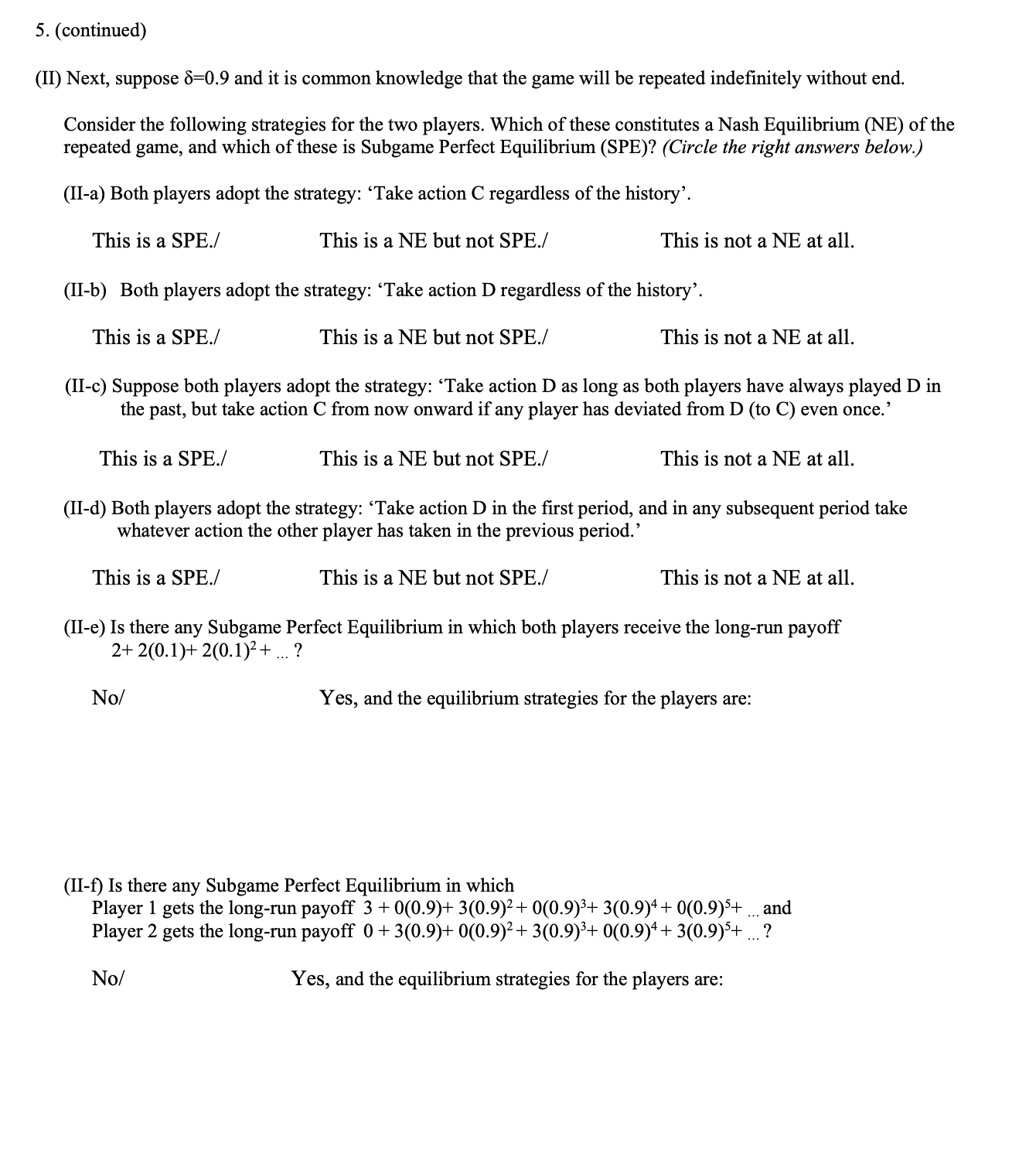
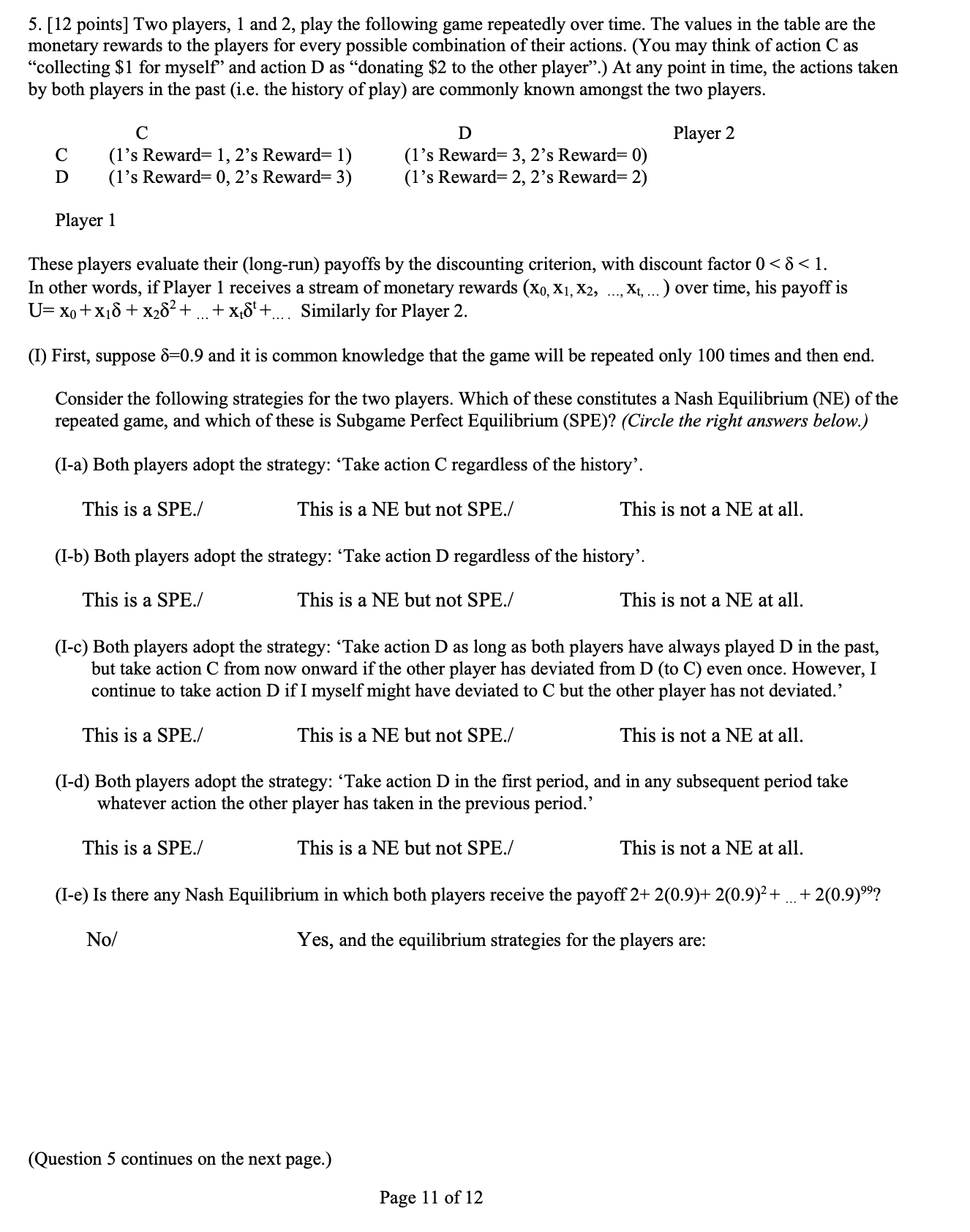
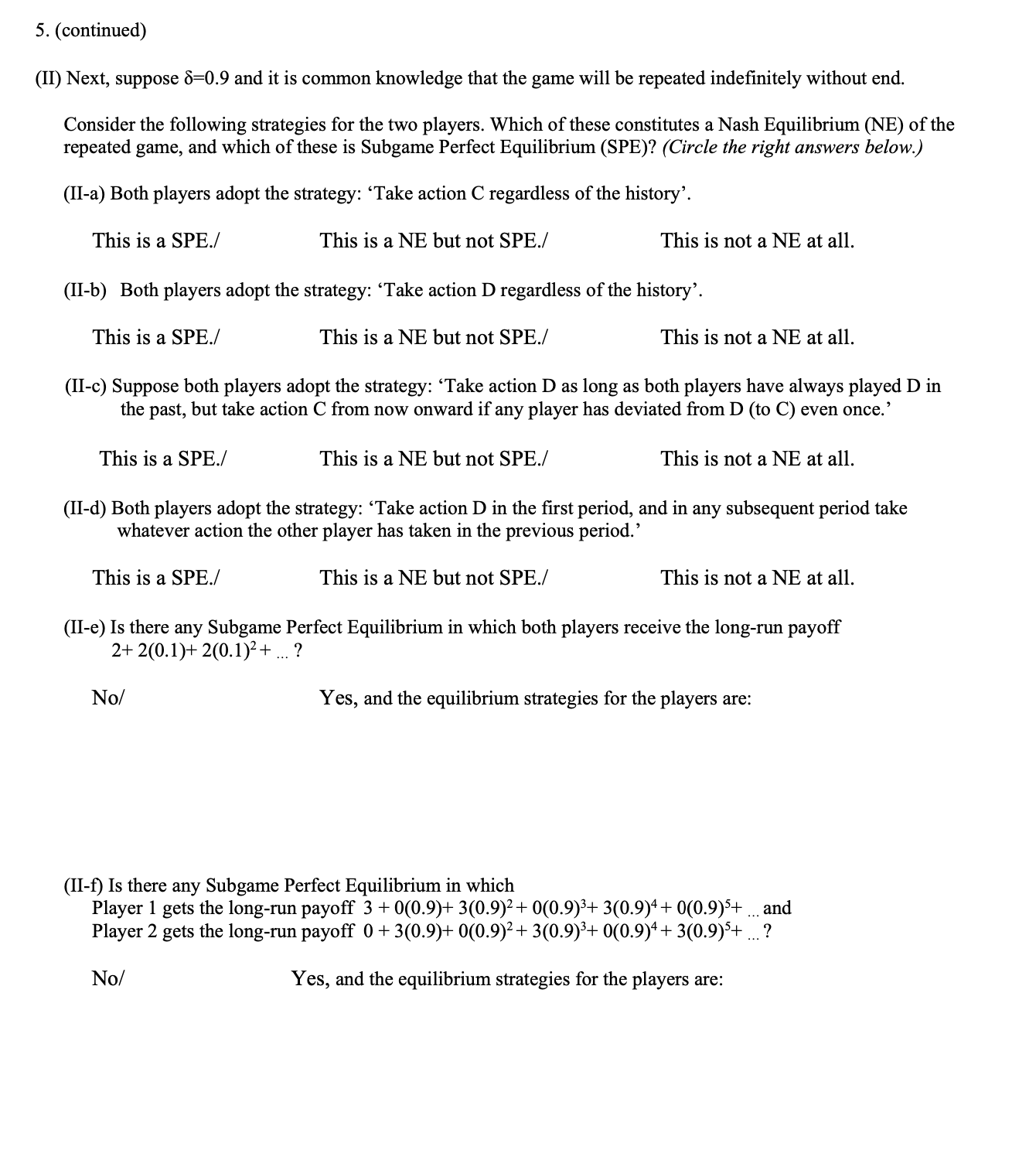
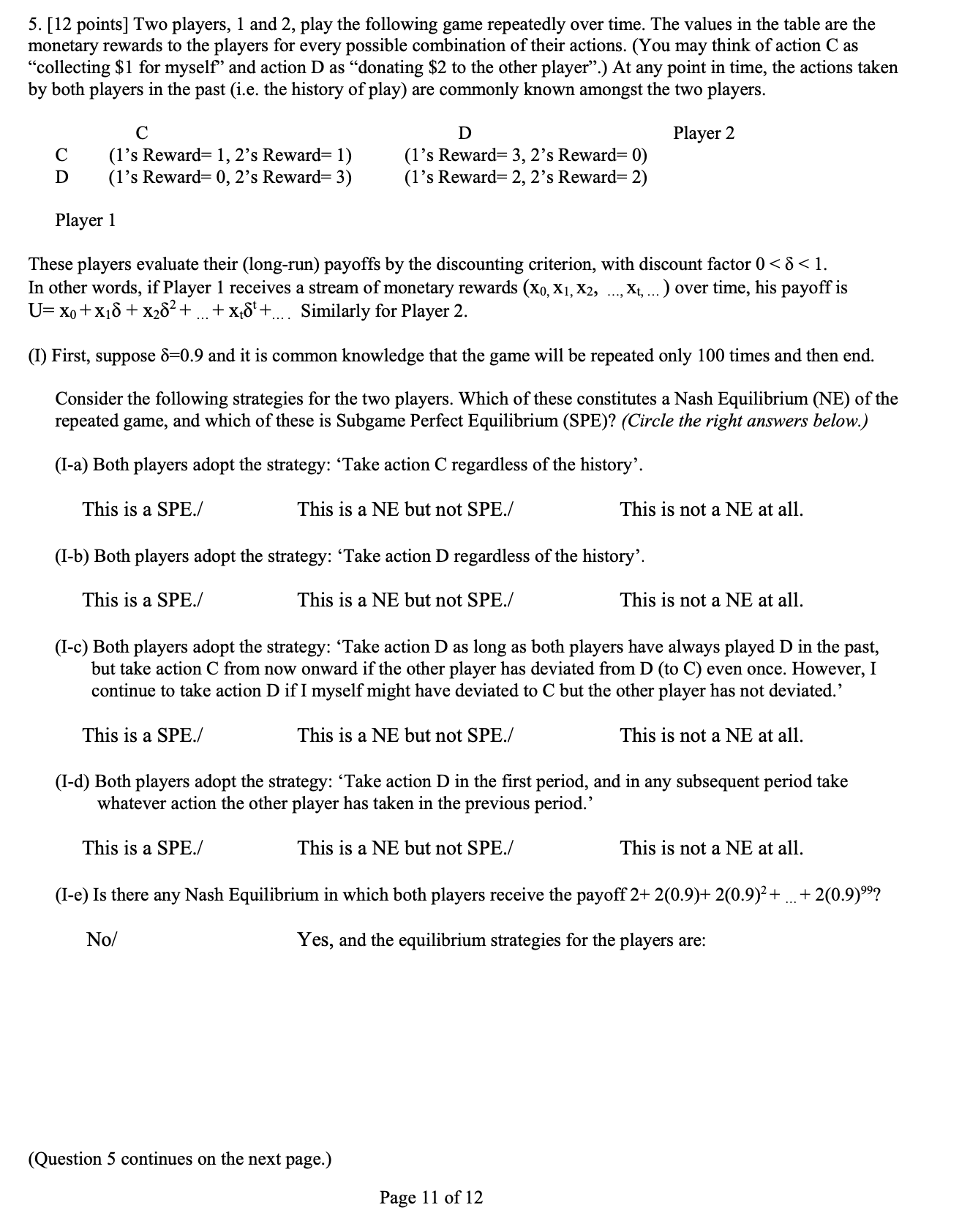
5. (continued) (ID Next, suppose 8=0.9 and it is common knowledge that the game will be repeated indenitely without end. Consider the following strategies for the two players. Which of these constitutes a Nash Equilibrium (NE) of the repeated game, and which of these is Subgame Perfect Equilibrium (SPE)? (Circle the right answers below.) (Ha) Both players adopt the strategy: 'Take action C regardless of the history'. This is a SPEJ This is a NE but not SPEJ This is not a NE at all. (IIb) Both players adopt the strategy: 'Take action D regardless of the history'. This is a SPEJ This is a NE but not SPEJ This is not a NE at all. (Hc) Suppose both players adopt the strategy: 'Take action D as long as both players have always played D in the past, but take action C from now onward if any player has deviated from D (to C) even once.' This is a SPE./ This is a NE but not SPEJ This is not a NE at all. (IId) Both players adopt the strategy: 'Take action D in the rst period, and in any subsequent period take whatever action the other player has taken in the previous period.' This is a SPEJ This is a NE but not SPEJ This is not a NE at all. (IIe) Is there any Subgame Perfect Equilibrium in which both players receive the longrun payoff 2+ 2(0.1)+ 2(0.1)2 + ? No/ Yes, and the equilibrium strategies for the players are: (II-f) Is there any Subgame Perfect Equilibrium in which Player 1 gets the long-run payoff 3 + 0(0.9)+ 3(O.9)2 + 0(0.9)3+ 3(0.9)4 + 0(0.9)5+ and Player 2 gets the long-run payoff 0 + 3(0.9)+ 0(0.9)2 + 3(0.9)3+ C(09)4 + 3(0.9)5+ ? No/ Yes, and the equilibrium strategies for the players are: S. [12 points] Two players, 1 and 2, play the following game repeatedly over time. The values in the table are the monetary rewards to the players for every possible combination of their actions. (You may think of action C as \"collecting $1 for myself\" and action D as \"donating $2 to the other player\".) At any point in time, the actions taken by both players in the past (ie. the history of play) are commonly known amongst the two players. C D Player 2 C (1's Reward= 1, 2's Reward= 1) (1's Reward= 3, 2's Reward= 0) D (1's Reward= 0, 2's Reward= 3) (1's Reward= 2, 2's Reward= 2) Player 1 These players evaluate their (long-run) payoffs by the discounting criterion, with discount factor 0
Step by Step Solution
There are 3 Steps involved in it

Get step-by-step solutions from verified subject matter experts