





Question: 5. [Lectures 29 and 30 will be relevant as background.) [This problem is similar to Chvtal, page 237, Problem 15.2. Consider a 'battleship' type game
5. [Lectures 29 and 30 will be relevant as
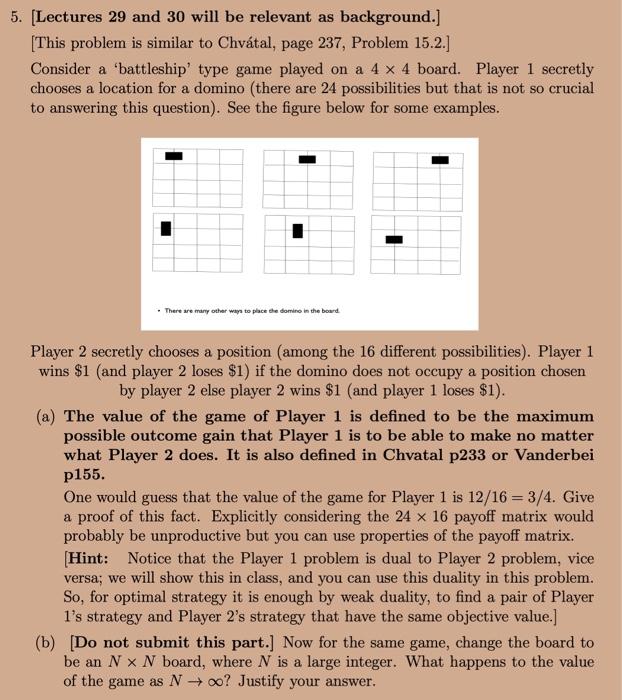
5. [Lectures 29 and 30 will be relevant as background.) [This problem is similar to Chvtal, page 237, Problem 15.2. Consider a 'battleship' type game played on a 4 x 4 board. Player 1 secretly chooses a location for a domino (there are 24 possibilities but that is not so crucial to answering this question). See the figure below for some examples. There are many other way to place de domino in the board Player 2 secretly chooses a position (among the 16 different possibilities). Player 1 wins $1 (and player 2 loses $1) if the domino does not occupy a position chosen by player 2 else player 2 wins $1 (and player 1 loses $1). (a) The value of the game of Player 1 is defined to be the maximum possible outcome gain that Player 1 is to be able to make no matter what Player 2 does. It is also defined in Chvatal p233 or Vanderbei p155. One would guess that the value of the game for Player 1 is 12/16 = 3/4. Give a proof of this fact. Explicitly considering the 24 x 16 payoff matrix would probably be unproductive but you can use properties of the payoff matrix. Hint: Notice that the Player 1 problem is dual to Player 2 problem, vice versa; we will show this in class, and you can use this duality in this problem. So, for optimal strategy it is enough by weak duality, to find a pair of Player 1's strategy and Player 2's strategy that have the same objective value. (b) (Do not submit this part.] Now for the same game, change the board to be an N x N board, where N is a large integer. What happens to the value of the game as No? Justify your answer. 5. [Lectures 29 and 30 will be relevant as background.) [This problem is similar to Chvtal, page 237, Problem 15.2. Consider a 'battleship' type game played on a 4 x 4 board. Player 1 secretly chooses a location for a domino (there are 24 possibilities but that is not so crucial to answering this question). See the figure below for some examples. There are many other way to place de domino in the board Player 2 secretly chooses a position (among the 16 different possibilities). Player 1 wins $1 (and player 2 loses $1) if the domino does not occupy a position chosen by player 2 else player 2 wins $1 (and player 1 loses $1). (a) The value of the game of Player 1 is defined to be the maximum possible outcome gain that Player 1 is to be able to make no matter what Player 2 does. It is also defined in Chvatal p233 or Vanderbei p155. One would guess that the value of the game for Player 1 is 12/16 = 3/4. Give a proof of this fact. Explicitly considering the 24 x 16 payoff matrix would probably be unproductive but you can use properties of the payoff matrix. Hint: Notice that the Player 1 problem is dual to Player 2 problem, vice versa; we will show this in class, and you can use this duality in this problem. So, for optimal strategy it is enough by weak duality, to find a pair of Player 1's strategy and Player 2's strategy that have the same objective value. (b) (Do not submit this part.] Now for the same game, change the board to be an N x N board, where N is a large integer. What happens to the value of the game as No? Justify your

Step by Step Solution

There are 3 Steps involved in it

1 Expert Approved Answer
Step: 1 Unlock blur-text-image

Question Has Been Solved by an Expert!

Get step-by-step solutions from verified subject matter experts

Step: 2 Unlock
Step: 3 Unlock

Students Have Also Explored These Related General Management Questions!