







Question: 5. [lpts] (Essay question, section 16.6) A simple physics formula is density equals mass divided by volume. In problem 2 above, the density was 6(33,
![5. [lpts] (Essay question, section 16.6) A simple physics formula is](https://s3.amazonaws.com/si.experts.images/answers/2024/06/66798badb3de4_64566798bad90bf1.jpg)
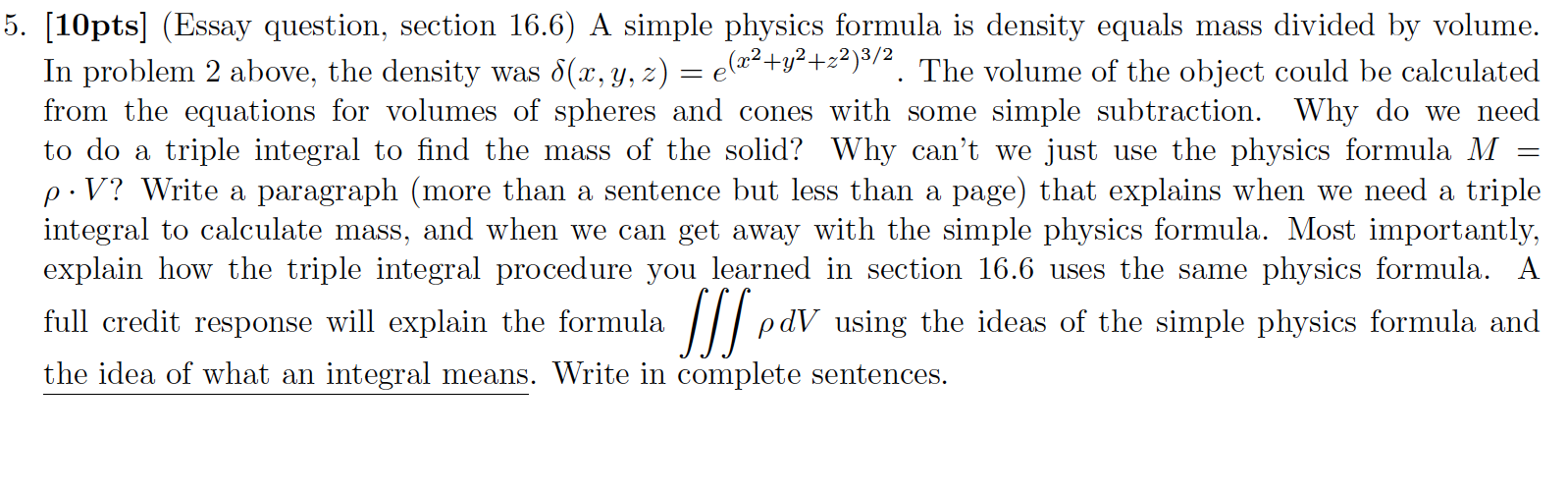
5. [lpts] (Essay question, section 16.6) A simple physics formula is density equals mass divided by volume. In problem 2 above, the density was 6(33, y, z) = e($2+y2+22)3/2. The volume of the object could be calculated from the equations for volumes of spheres and cones with some simple subtraction. Why do we need to do a triple integral to nd the mass of the solid? Why can't we just use the physics formula M = p - V? Write a paragraph (more than a sentence but less than a page) that explains when we need a triple integral to calculate mass, and when we can get away with the simple physics formula. Most importantly, explain how the triple integral procedure you learned in section 16.6 uses the same physics formula. A full credit response will explain the formula fff pdV using the ideas of the simple physics formula and the idea of what an integral means. Write in complete sentences
Step by Step Solution
There are 3 Steps involved in it

Get step-by-step solutions from verified subject matter experts
 Study Help