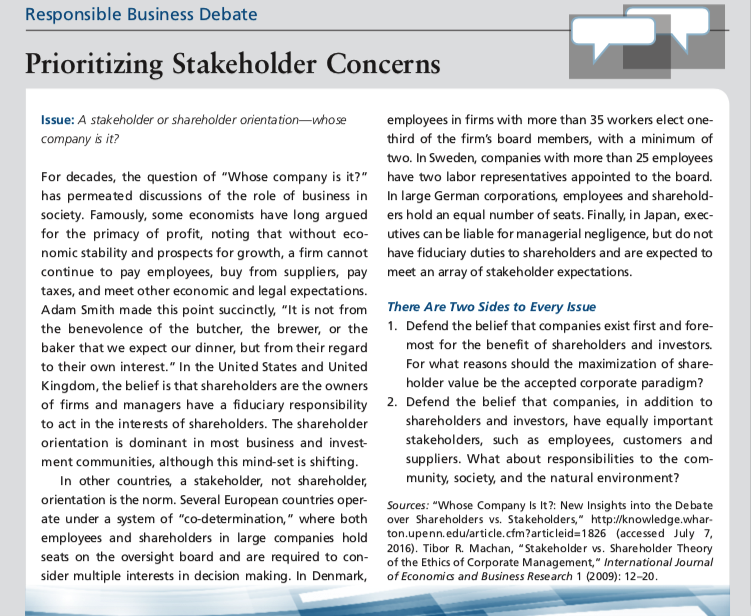
Question: Read the two Articles above, then read the special feature below and answer the question Responsible Business Debate Prioritizing Stakeholder Concerns Issue: A stakeholder or
Read the two Articles above, then read the special feature below and answer the question
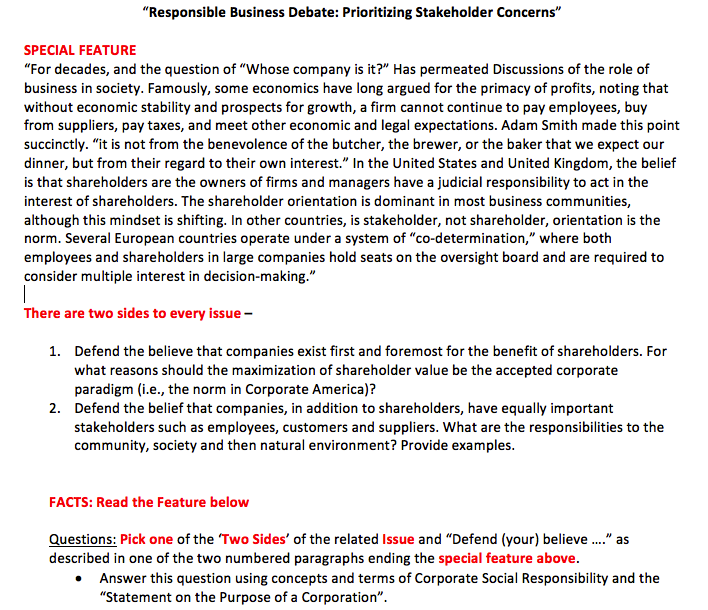
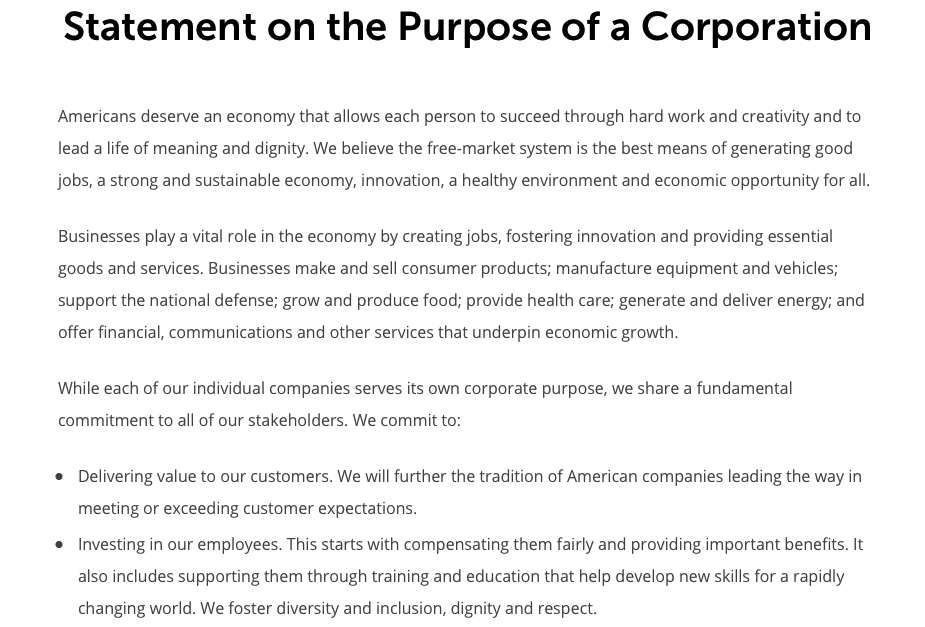
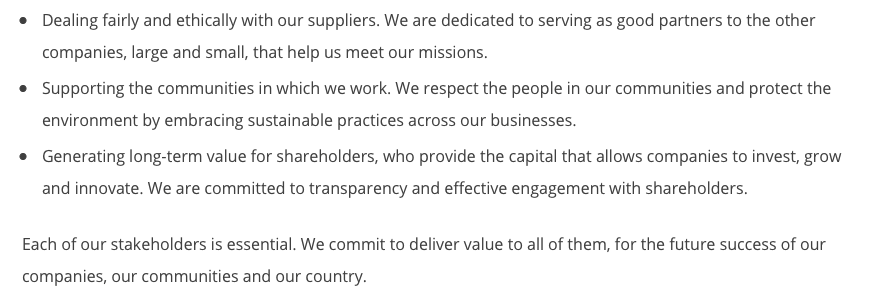
Responsible Business Debate Prioritizing Stakeholder Concerns Issue: A stakeholder or shareholder orientationwhose employees in firms with more than 35 workers elect one- company is it? third of the firm's board members, with a minimum of two. In Sweden, companies with more than 25 employees For decades, the question of "Whose company is it?" have two labor representatives appointed to the board. has permeated discussions of the role of business in in large German corporations, employees and sharehold- society. Famously, some economists have long argued ers hold an equal number of seats. Finally, in Japan, exec- for the primacy of profit, noting that without eco-utives can be liable for managerial negligence, but do not nomic stability and prospects for growth, a firm cannot have fiduciary duties to shareholders and are expected to continue to pay employees, buy from suppliers, pay meet an array of stakeholder expectations. taxes, and meet other economic and legal expectations. Adam Smith made this point succinctly, "It is not from There Are Two Sides to Every Issue the benevolence of the butcher, the brewer, or the 1. Defend the belief that companies exist first and fore- baker that we expect our dinner, but from their regard most for the benefit of shareholders and investors. to their own interest." In the United States and United For what reasons should the maximization of share- Kingdom, the belief is that shareholders are the owners holder value be the accepted corporate paradigm? of firms and managers have a fiduciary responsibility 2. Defend the belief that companies, in addition to to act in the interests of shareholders. The shareholder shareholders and investors, have equally important orientation is dominant in most business and invest stakeholders, such as employees, customers and ment communities, although this mind-set is shifting. suppliers. What about responsibilities to the com- In other countries, a stakeholder, not shareholder, munity, society, and the natural environment? orientation is the norm. Several European countries oper- Sources: "Whose Company Is It?: New Insights into the Debate ate under a system of "co-determination," where both over Shareholders vs. Stakeholders," http://knowledge.whar- employees and shareholders in large companies hold ton.upenn.edu/article.cfm?articleid=1826 (accessed July 7, seats on the oversight board and are required to con-2016) . Tibor R. Machan, Stakeholder vs. Shareholder Theory of the Ethics of Corporate Management, International Journal sider multiple interests in decision making. In Denmark, of Economics and Business Research 1 (2009): 12-20. Statement on the Purpose of a Corporation Americans deserve an economy that allows each person to succeed through hard work and creativity and to lead a life of meaning and dignity. We believe the free-market system is the best means of generating good jobs, a strong and sustainable economy, innovation, a healthy environment and economic opportunity for all. Businesses play a vital role in the economy by creating jobs, fostering innovation and providing essential goods and services. Businesses make and sell consumer products; manufacture equipment and vehicles; support the national defense; grow and produce food; provide health care; generate and deliver energy; and offer financial, communications and other services that underpin economic growth. While each of our individual companies serves its own corporate purpose, we share a fundamental commitment to all of our stakeholders. We commit to: Delivering value to our customers. We will further the tradition of American companies leading the way in meeting or exceeding customer expectations. Investing in our employees. This starts with compensating them fairly and providing important benefits. It also includes supporting them through training and education that help develop new skills for a rapidly changing world. We foster diversity and inclusion, dignity and respect. Dealing fairly and ethically with our suppliers. We are dedicated to serving as good partners to the other companies, large and small, that help us meet our missions. Supporting the communities in which we work. We respect the people in our communities and protect the environment by embracing sustainable practices across our businesses. Generating long-term value for shareholders, who provide the capital that allows companies to invest, grow and innovate. We are committed to transparency and effective engagement with shareholders. Each of our stakeholders is essential. We commit to deliver value to all of them, for the future success of our companies, our communities and our country. "Responsible Business Debate: Prioritizing Stakeholder Concerns" SPECIAL FEATURE "For decades, and the question of "Whose company is it?" Has permeated Discussions of the role of business in society. Famously, some economics have long argued for the primacy of profits, noting that without economic stability and prospects for growth, a firm cannot continue to pay employees, buy from suppliers, pay taxes, and meet other economic and legal expectations. Adam Smith made this point succinctly. "it is not from the benevolence of the butcher, the brewer, or the baker that we expect our dinner, but from their regard to their own interest." In the United States and United Kingdom, the belief is that shareholders are the owners of firms and managers have a judicial responsibility to act in the interest of shareholders. The shareholder orientation is dominant in most business communities, although this mindset is shifting. In other countries, is stakeholder, not shareholder, orientation is the norm. Several European countries operate under a system of "co-determination," where both employees and shareholders in large companies hold seats on the oversight board and are required to consider multiple interest in decision-making." There are two sides to every issue - 1. Defend the believe that companies exist first and foremost for the benefit of shareholders. For what reasons should the maximization of shareholder value be the accepted corporate paradigm (i.e., the norm in Corporate America)? 2. Defend the belief that companies, in addition to shareholders, have equally important stakeholders such as employees, customers and suppliers. What are the responsibilities to the community, society and then natural environment? Provide examples. FACTS: Read the Feature below Questions: Pick one of the 'Two Sides' of the related issue and "Defend (your) believe...." as described in one of the two numbered paragraphs ending the special feature above. Answer this question using concepts and terms of Corporate Social Responsibility and the "Statement on the Purpose of a Corporation









 Study Help