







Question: 5 questions, 20 points each.(show all work) #1-a) Convert 685(10)Binary(2)Octal(8)Hex(16) b) Draw a 64X1 Mux given 8X1 Muxes and 2X1 Muxes c) Draw a decoder
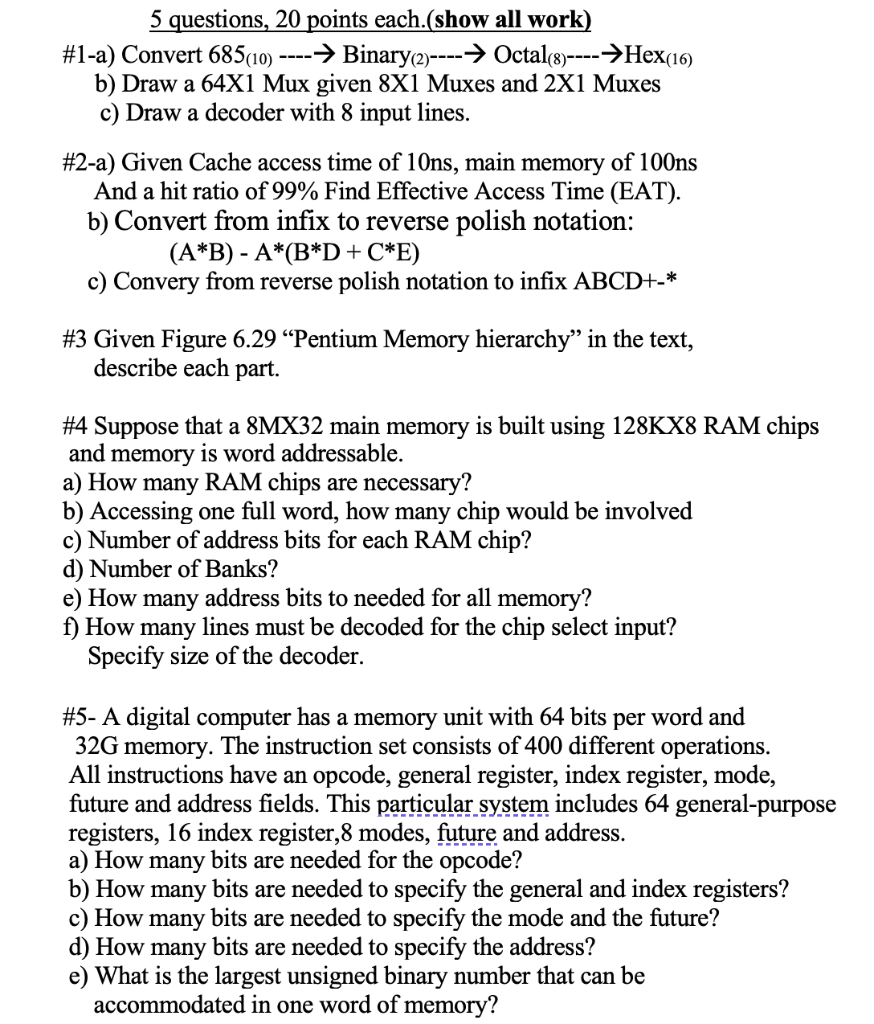
5 questions, 20 points each.(show all work) \#1-a) Convert 685(10)Binary(2)Octal(8)Hex(16) b) Draw a 64X1 Mux given 8X1 Muxes and 2X1 Muxes c) Draw a decoder with 8 input lines. \#2-a) Given Cache access time of 10ns, main memory of 100ns And a hit ratio of 99% Find Effective Access Time (EAT). b) Convert from infix to reverse polish notation: (AB)A(BD+CE) c) Convery from reverse polish notation to infix ABCD+ \#3 Given Figure 6.29 "Pentium Memory hierarchy" in the text, describe each part. \#4 Suppose that a 8MX32 main memory is built using 128KX8 RAM chips and memory is word addressable. a) How many RAM chips are necessary? b) Accessing one full word, how many chip would be involved c) Number of address bits for each RAM chip? d) Number of Banks? e) How many address bits to needed for all memory? f) How many lines must be decoded for the chip select input? Specify size of the decoder. \#5- A digital computer has a memory unit with 64 bits per word and 32G memory. The instruction set consists of 400 different operations. All instructions have an opcode, general register, index register, mode, future and address fields. This particular system includes 64 general-purpose registers, 16 index register, 8 modes, futuren and address. a) How many bits are needed for the opcode? b) How many bits are needed to specify the general and index registers? c) How many bits are needed to specify the mode and the future? d) How many bits are needed to specify the address? e) What is the largest unsigned binary number that can be accommodated in one word of memory
Step by Step Solution
There are 3 Steps involved in it

Get step-by-step solutions from verified subject matter experts
 Study Help