







Question: 5) (Real world problem) There is an elevator in a sixteen story office building. You must design a sequential control circuit for the elevator that
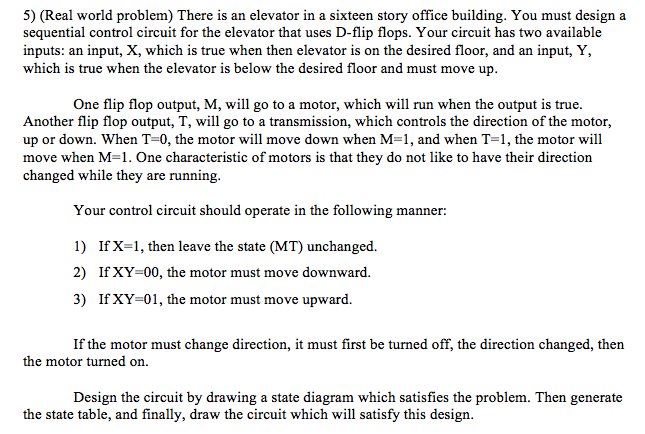
5) (Real world problem) There is an elevator in a sixteen story office building. You must design a sequential control circuit for the elevator that uses D-flip flops. Your circuit has two available inputs: an input, X, which is true when then elevator is on the desired floor, and an input, Y, which is true when the elevator is below the desired floor and must move up. One flip flop output, M, will go to a motor, which wll run when the output is true. Another flip flop output, T, will go to a transmission, which controls the direction of the motor, up or down. When T-0, the motor will move down when M=1, and when T-1, the motor will move when M-1. One characteristic of motors is that they do not like to have their direction changed while they are running. Your control circuit should operate in the following manner: 1) IfX-1, then leave the state (MT) unchanged. 2) If XY-00, the motor must move downward. 3) If XY-01, the motor must move upward. If the motor must change direction, it must first be turned off, the direction changed, then the motor turned on Design the circuit by drawing a state diagram which satisfies the problem. Then generate the state table, and finally, draw the circuit which will satisfy this design 5) (Real world problem) There is an elevator in a sixteen story office building. You must design a sequential control circuit for the elevator that uses D-flip flops. Your circuit has two available inputs: an input, X, which is true when then elevator is on the desired floor, and an input, Y, which is true when the elevator is below the desired floor and must move up. One flip flop output, M, will go to a motor, which wll run when the output is true. Another flip flop output, T, will go to a transmission, which controls the direction of the motor, up or down. When T-0, the motor will move down when M=1, and when T-1, the motor will move when M-1. One characteristic of motors is that they do not like to have their direction changed while they are running. Your control circuit should operate in the following manner: 1) IfX-1, then leave the state (MT) unchanged. 2) If XY-00, the motor must move downward. 3) If XY-01, the motor must move upward. If the motor must change direction, it must first be turned off, the direction changed, then the motor turned on Design the circuit by drawing a state diagram which satisfies the problem. Then generate the state table, and finally, draw the circuit which will satisfy this design
Step by Step Solution
There are 3 Steps involved in it

Get step-by-step solutions from verified subject matter experts
 Study Help