



Question: 5. Silicatein, the molecule recognised as responsible for biosilicification in sponge spicules, was successfully used to synthesise SiO2 in vitro. i. Discuss the nature of
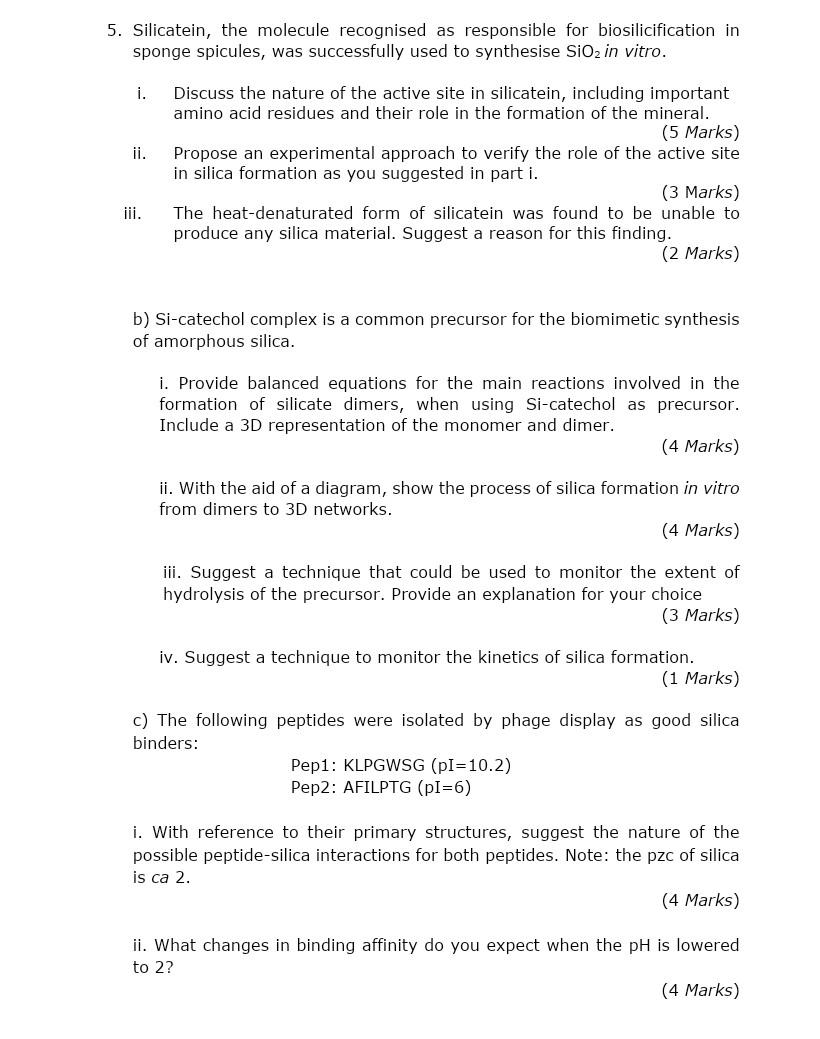
5. Silicatein, the molecule recognised as responsible for biosilicification in sponge spicules, was successfully used to synthesise SiO2 in vitro. i. Discuss the nature of the active site in silicatein, including important amino acid residues and their role in the formation of the mineral. (5 Marks) ii. Propose an experimental approach to verify the role of the active site in silica formation as you suggested in part i. (3 Marks) iii. The heat-denaturated form of silicatein was found to be unable to produce any silica material. Suggest a reason for this finding. (2 Marks) b) Si-catechol complex is a common precursor for the biomimetic synthesis of amorphous silica. i. Provide balanced equations for the main reactions involved in the formation of silicate dimers, when using Si-catechol as precursor. Include a 3D representation of the monomer and dimer. (4 Marks) ii. With the aid of a diagram, show the process of silica formation in vitro from dimers to 3D networks. (4 Marks) iii. Suggest a technique that could be used to monitor the extent of hydrolysis of the precursor. Provide an explanation for your choice (3 Marks) iv. Suggest a technique to monitor the kinetics of silica formation. (1 Marks) c) The following peptides were isolated by phage display as good silica binders: Pep1: KLPGWSG ( pI=10.2) Pep2: AFILPTG (pI=6) i. With reference to their primary structures, suggest the nature of the possible peptide-silica interactions for both peptides. Note: the pzc of silica is ca 2 . (4 Marks) ii. What changes in binding affinity do you expect when the pH is lowered to 2 ? (4 Marks)
Step by Step Solution
There are 3 Steps involved in it

Get step-by-step solutions from verified subject matter experts