







Question: 5. Suppose that u( 3, y) is a continuously differentiable, circularly symmetric function, so that when expressed in polar coordinates, I = roos, , y
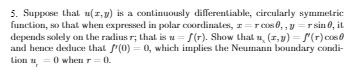
5. Suppose that u( 3, y) is a continuously differentiable, circularly symmetric function, so that when expressed in polar coordinates, I = roos, , y = rain, it depends solely on the rixliusr; that is w = / (r). Show that a (x,y) = /(r) cost and hence deduce that /(0) = 0, which implies the Neumann boundary condi- lion u = 0 when r = (
Step by Step Solution
There are 3 Steps involved in it
1 Expert Approved Answer
Step: 1 Unlock

Question Has Been Solved by an Expert!
Get step-by-step solutions from verified subject matter experts
Step: 2 Unlock
Step: 3 Unlock
 Study Help