







Question: 5. The Reverse Logistic Equation Consider the initial-value problem dP = -kP/1 dt (1-B) P(0) = Po where k > 0 and B > 0
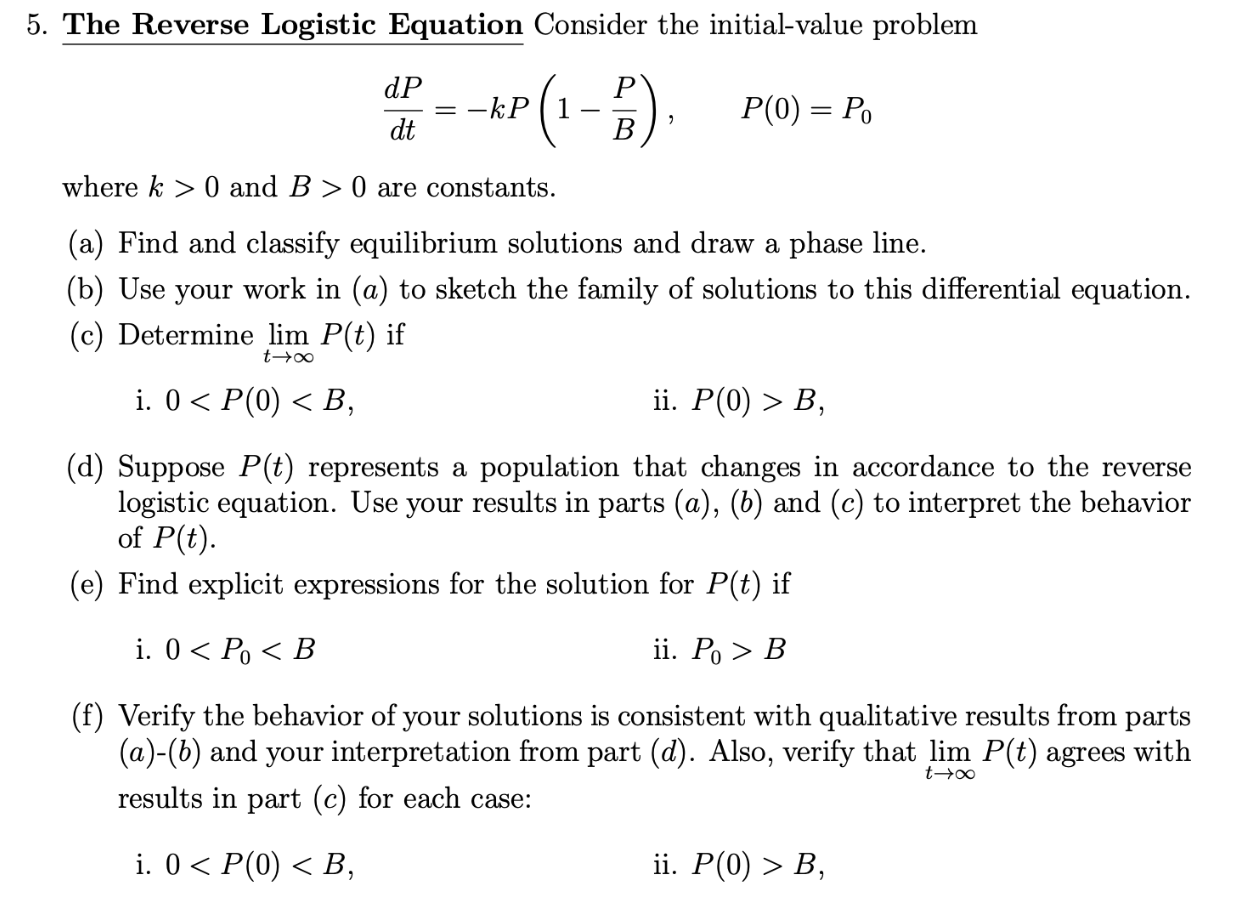
5. The Reverse Logistic Equation Consider the initial-value problem dP = -kP/1 dt (1-B) P(0) = Po where k > 0 and B > 0 are constants. (a) Find and classify equilibrium solutions and draw a phase line. (b) Use your work in (a) to sketch the family of solutions to this differential equation. (c) Determine lim P(t) if too i. 0 B, (d) Suppose P(t) represents a population that changes in accordance to the reverse logistic equation. Use your results in parts (a), (b) and (c) to interpret the behavior of P(t). (e) Find explicit expressions for the solution for P(t) if i. 0 B (f) Verify the behavior of your solutions is consistent with qualitative results from parts (a)-(6) and your interpretation from part (d). Also, verify that lim P(t) agrees with results in part (c) for each case: too i. 0 B, 5. The Reverse Logistic Equation Consider the initial-value problem dP = -kP/1 dt (1-B) P(0) = Po where k > 0 and B > 0 are constants. (a) Find and classify equilibrium solutions and draw a phase line. (b) Use your work in (a) to sketch the family of solutions to this differential equation. (c) Determine lim P(t) if too i. 0 B, (d) Suppose P(t) represents a population that changes in accordance to the reverse logistic equation. Use your results in parts (a), (b) and (c) to interpret the behavior of P(t). (e) Find explicit expressions for the solution for P(t) if i. 0 B (f) Verify the behavior of your solutions is consistent with qualitative results from parts (a)-(6) and your interpretation from part (d). Also, verify that lim P(t) agrees with results in part (c) for each case: too i. 0 B
Step by Step Solution
There are 3 Steps involved in it

Get step-by-step solutions from verified subject matter experts
 Study Help