







Question: 5 (Un conditional (In)equalities Let us consider a sample space 2 = {@1, ..., ON} of size N > 2, and two probability functions P1
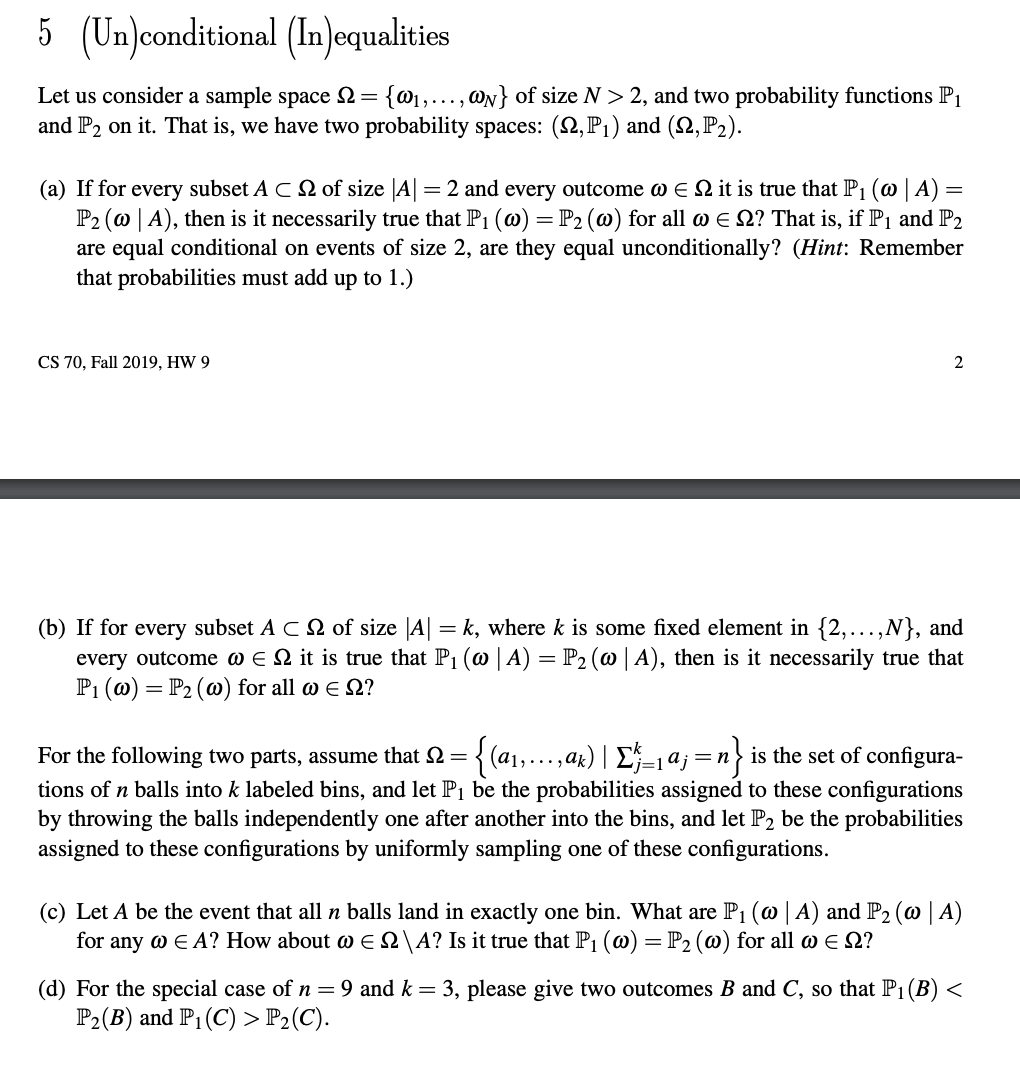
5 (Un conditional (In)equalities Let us consider a sample space 2 = {@1, ..., ON} of size N > 2, and two probability functions P1 and P2 on it. That is, we have two probability spaces: (2, P1 ) and (2, P2). (a) If for every subset A C S of size A = 2 and every outcome @ E 2 it is true that P1 (@ | A) = P2 (@ |A), then is it necessarily true that Pi () = P2 (@) for all @ E S? That is, if P1 and P2 are equal conditional on events of size 2, are they equal unconditionally? (Hint: Remember that probabilities must add up to 1.) CS 70, Fall 2019, HW 9 2 (b) If for every subset A C 2 of size |A| = k, where k is some fixed element in {2, ..., N}, and every outcome w E 2 it is true that P1 (@ | A) = P2 (@ | A), then is it necessarily true that P1 (@) = P2 (w) for all w E ? For the following two parts, assume that 2 = (a1, ..., ax) | Eh_laj =n. is the set of configura- tions of n balls into k labeled bins, and let P1 be the probabilities assigned to these configurations by throwing the balls independently one after another into the bins, and let P2 be the probabilities assigned to these configurations by uniformly sampling one of these configurations. (c) Let A be the event that all n balls land in exactly one bin. What are PI (@ | A) and P2 (@ | A) for any @ E A? How about w E 2 \\ A? Is it true that P1 (@) = P2 (@) for all @ E ? (d) For the special case of n = 9 and k = 3, please give two outcomes B and C, so that P1 (B) P2(C)
Step by Step Solution
There are 3 Steps involved in it

Get step-by-step solutions from verified subject matter experts
 Study Help