







Question: #####@ 5. What is RAROC? How does this model use the concept of duration to measure the risk exposure of a loan? How is the
#####@
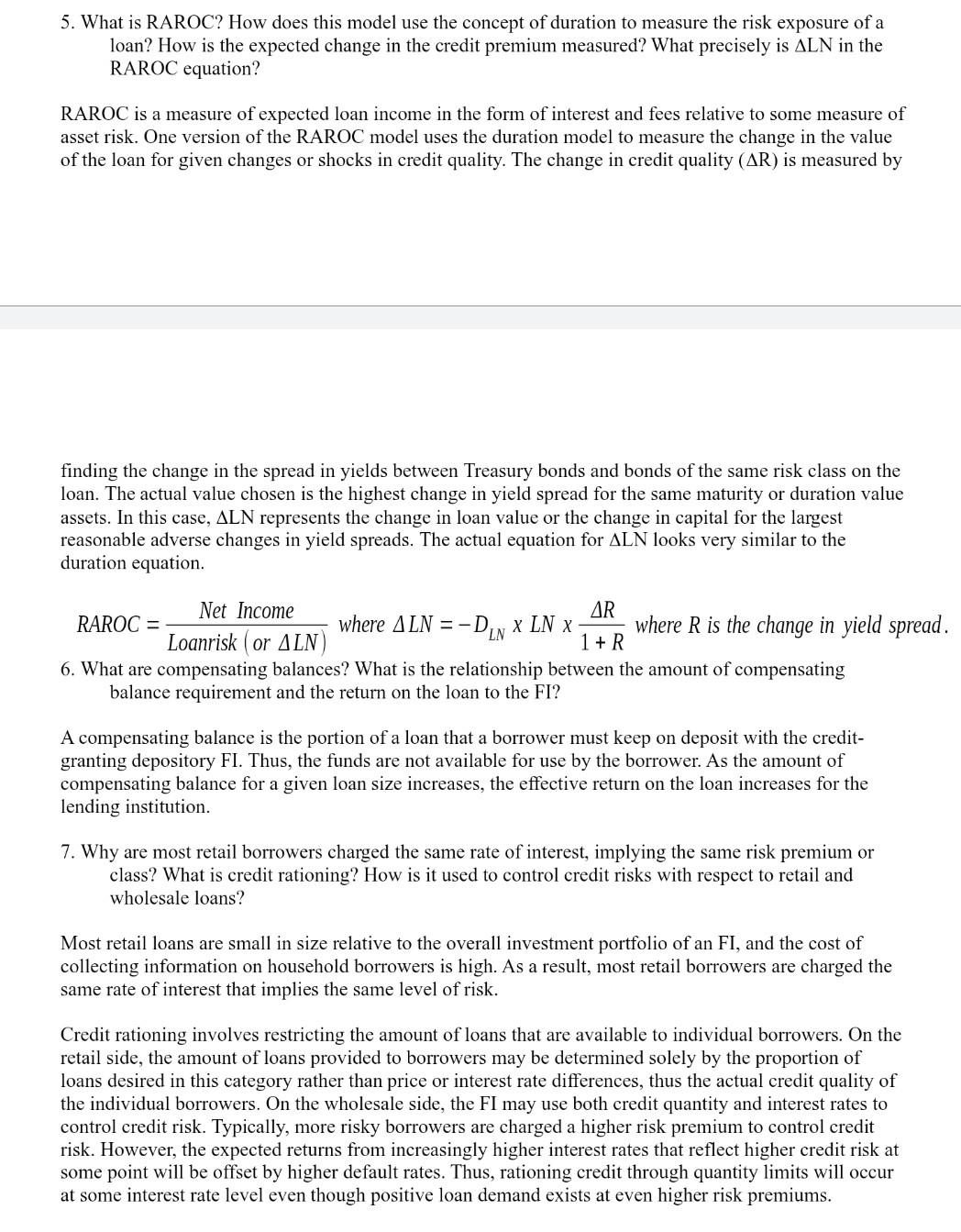
5. What is RAROC? How does this model use the concept of duration to measure the risk exposure of a loan? How is the expected change in the credit premium measured? What precisely is ALN in the RAROC equation? RAROC is a measure of expected loan income in the form of interest and fees relative to some measure of asset risk. One version of the RAROC model uses the duration model to measure the change in the value of the loan for given changes or shocks in credit quality. The change in credit quality (AR) is measured by finding the change in the spread in yields between Treasury bonds and bonds of the same risk class on the loan. The actual value chosen is the highest change in yield spread for the same maturity or duration value assets. In this case, ALN represents the change in loan value or the change in capital for the largest reasonable adverse changes in yield spreads. The actual equation for ALN looks very similar to the duration equation. Net Income AR RAROC = where ALN = - DIN X LN X where R is the change in yield spread. Loanrisk or ALN 1 + R 6. What are compensating balances? What is the relationship between the amount of compensating balance requirement and the return on the loan to the FI? A compensating balance is the portion of a loan that a borrower must keep on deposit with the credit- granting depository FI. Thus, the funds are not available for use by the borrower. As the amount of compensating balance for a given loan size increases, the effective return on the loan increases for the lending institution. 7. Why are most retail borrowers charged the same rate of interest, implying the same risk premium or class? What is credit rationing? How is it used to control credit risks with respect to retail and wholesale loans? Most retail loans are small in size relative to the overall investment portfolio of an FI, and the cost of collecting information on household borrowers is high. As a result, most retail borrowers are charged the same rate of interest that implies the same level of risk. Credit rationing involves restricting the amount of loans that are available to individual borrowers. On the retail side, the amount of loans provided to borrowers may be determined solely by the proportion of loans desired in this category rather than price or interest rate differences, thus the actual credit quality of the individual borrowers. On the wholesale side, the FI may use both credit quantity and interest rates to control credit risk. Typically, more risky borrowers are charged a higher risk premium to control credit risk. However, the expected returns from increasingly higher interest rates that reflect higher credit risk at some point will be offset by higher default rates. Thus, rationing credit through quantity limits will occur at some interest rate level even though positive loan demand exists at even higher risk premiumsStep by Step Solution
There are 3 Steps involved in it
1 Expert Approved Answer
Step: 1 Unlock

Question Has Been Solved by an Expert!
Get step-by-step solutions from verified subject matter experts
Step: 2 Unlock
Step: 3 Unlock
 Study Help