







Question: ( 6 0 pt ) ( a ) ( 2 0 pt ) Consider a linear diffusion equation ( delu ) / ( delt )
pt
apt Consider a linear diffusion equation
deludeltalpha deludelx
Discretize it using a numerical scheme of your choice. Perform the consistency analysis, obtaining an
expression for the truncation error.
bpt Describe the amplification factor G in von Newman stability analysis. Consider a linear convection
equation as
deludeltadeludelx
Apply a numerical scheme where you discretize the both time and space terms using the second order
central difference formula. Perform the von Neumann stability analysis to discuss its stability.
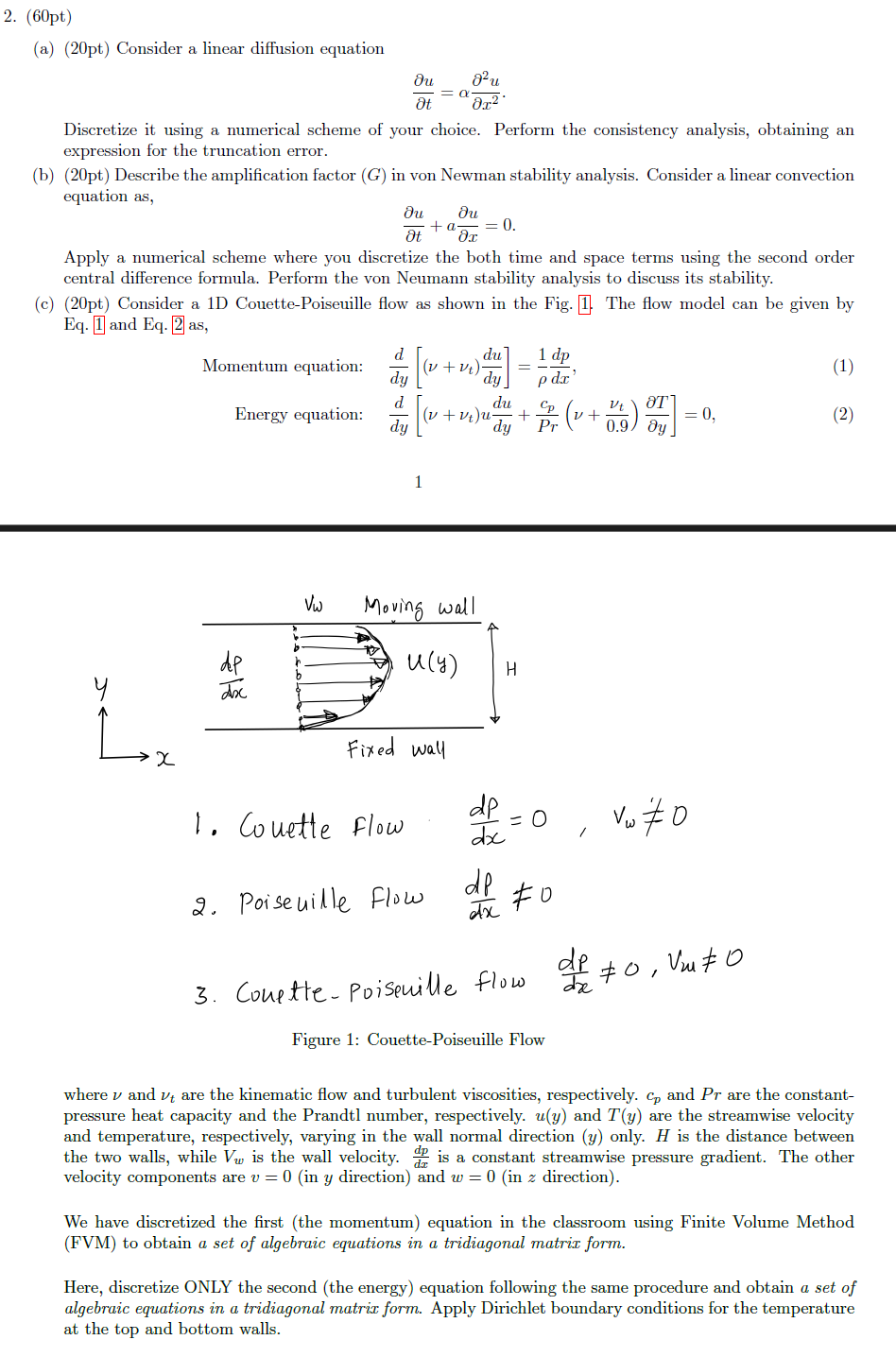
cpt Consider a D CouettePoiseuille flow as shown in the Fig. The flow model can be given by
Eq and Eq as
Momentum equation:
ddy
u
u tdudyrho dpdx
ddy
u
u tududycpPr
u
u tdelTdely
Couette flow dpdxvw
Poisenille flow dPdx
Conettepoisenille flow dpdxVu
Figure : CouettePoiseuille Flow
where
u and
u t are the kinematic flow and turbulent viscosities, respectively. cp and Pr are the constant
pressure heat capacity and the Prandtl number, respectively. uy and Ty are the streamwise velocity
and temperature, respectively, varying in the wall normal direction y only. H is the distance between
the two walls, while Vw is the wall velocity. dpdx is a constant streamwise pressure gradient. The other
velocity components are vy directionwz direction
Step by Step Solution
There are 3 Steps involved in it
1 Expert Approved Answer
Step: 1 Unlock

Question Has Been Solved by an Expert!
Get step-by-step solutions from verified subject matter experts
Step: 2 Unlock
Step: 3 Unlock
 Study Help