







Question: 6. An object moves at constant speed toward a solid barrier (A). It strikes the barrier (B) and is reflected (C) as shown in the
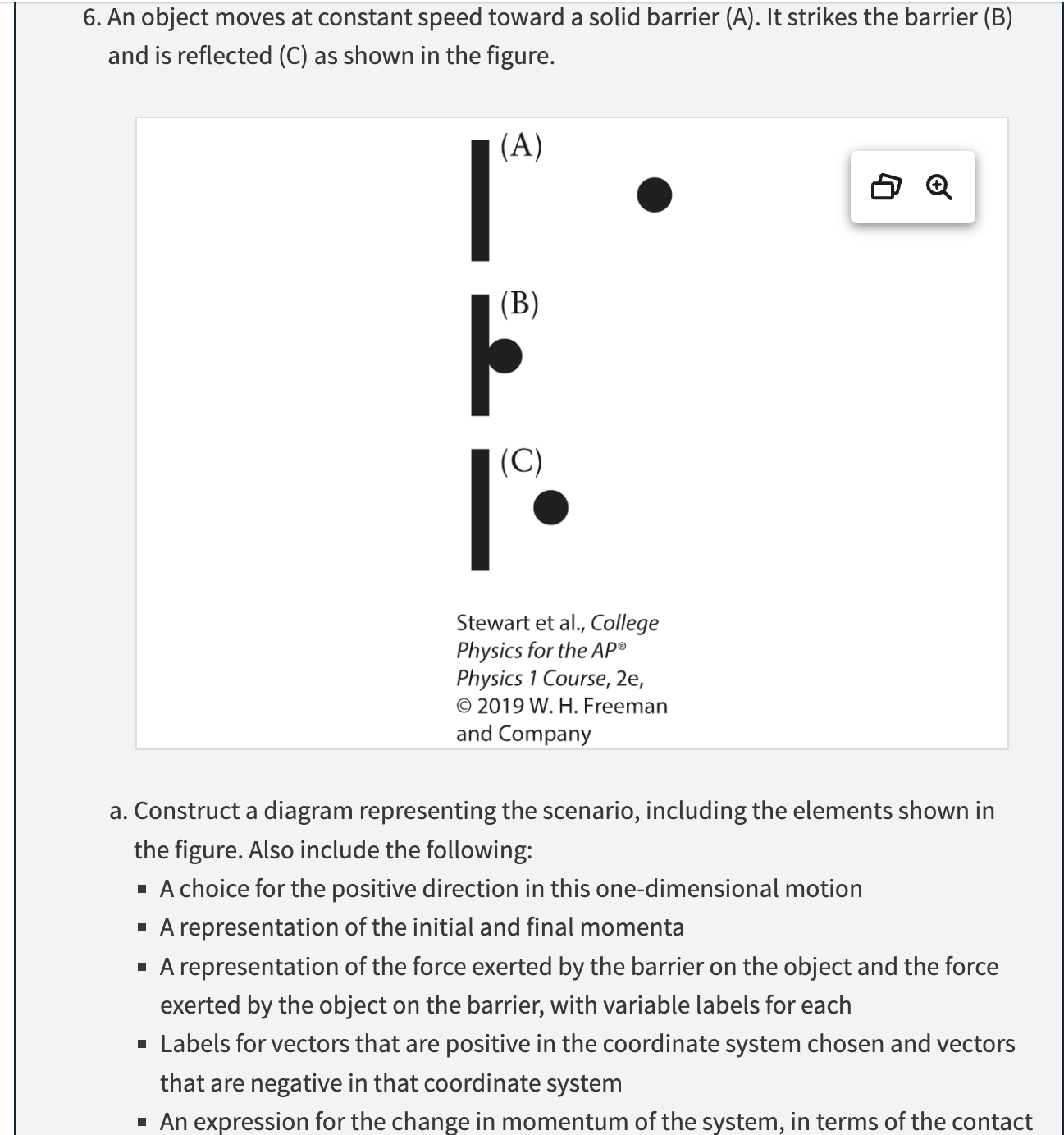
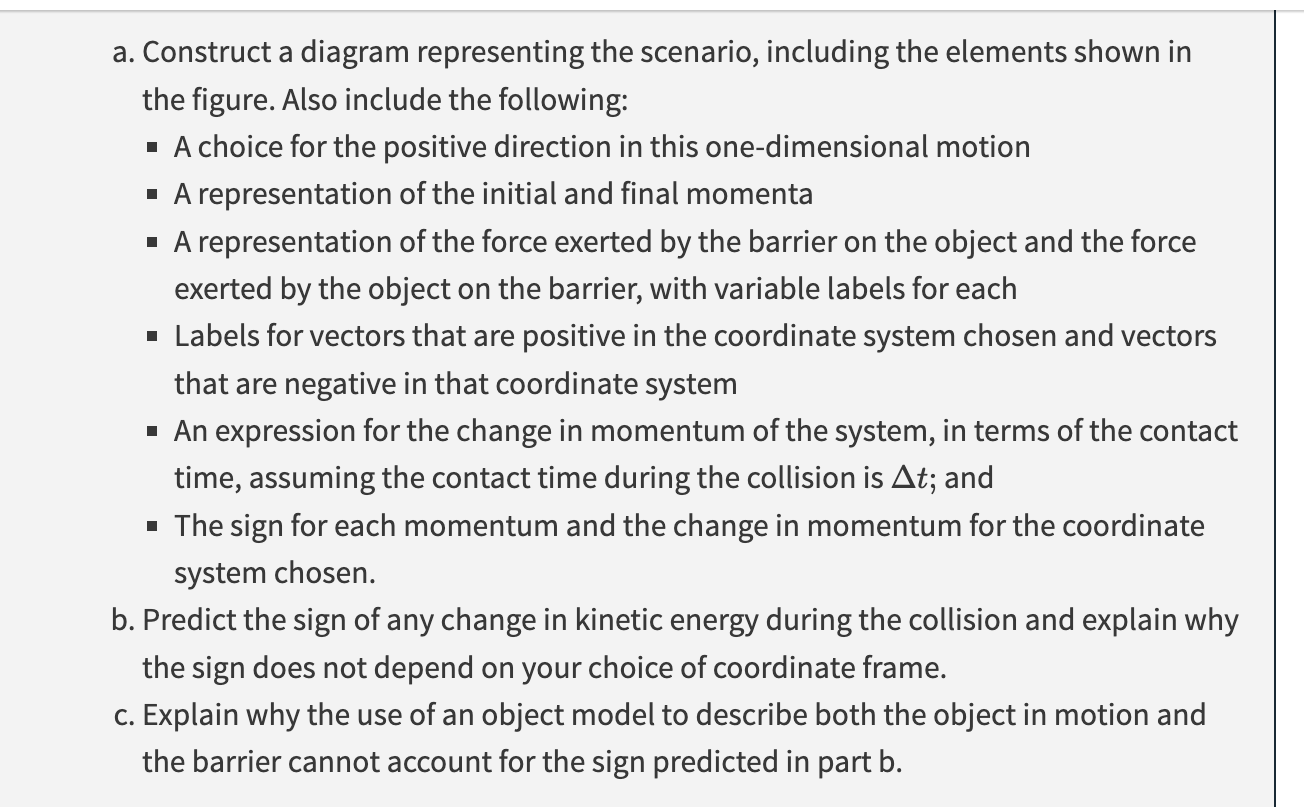
6. An object moves at constant speed toward a solid barrier (A). It strikes the barrier (B) and is reflected (C) as shown in the figure. (A) . I57 Q (B) (C) 0 Stewart et al., College Physics for the AP Physics 1' Course, 2e, 2019 W. H. Freeman and Company a. Construct a diagram representing the scenario, including the elements shown in the figure. Also include the following: - A choice for the positive direction in this one-dimensional motion - A representation of the initial and final momenta I A representation of the force exerted by the barrier on the object and the force exerted by the object on the barrier, with variable labels for each I Labels for vectors that are positive in the coordinate system chosen and vectors that are negative in that coordinate system - An expression for the change in momentum of the system, in terms of the contact a. Construct a diagram representing the scenario, including the elements shown in the figure. Also include the following: A choice for the positive direction in this onedimensional motion A representation of the initial and final momenta A representation of the force exerted by the barrier on the object and the force exerted by the object on the barrier, with variable labels for each Labels for vectors that are positive in the coordinate system chosen and vectors that are negative in that coordinate system An expression for the change in momentum of the system, in terms of the contact time, assuming the contact time during the collision is At; and The sign for each momentum and the change in momentum for the coordinate system chosen. b. Predict the sign of any change in kinetic energy during the collision and explain why the sign does not depend on your choice of coordinate frame. c. Explain why the use of an object model to describe both the object in motion and the barrier cannot account for the sign predicted in part b
Step by Step Solution
There are 3 Steps involved in it

Get step-by-step solutions from verified subject matter experts
 Study Help