







Question: 6. (Extra Credit - Adapted from Evan Porteus) Consider a specific airline flight on a specific day with a fixed number n of seats. (You
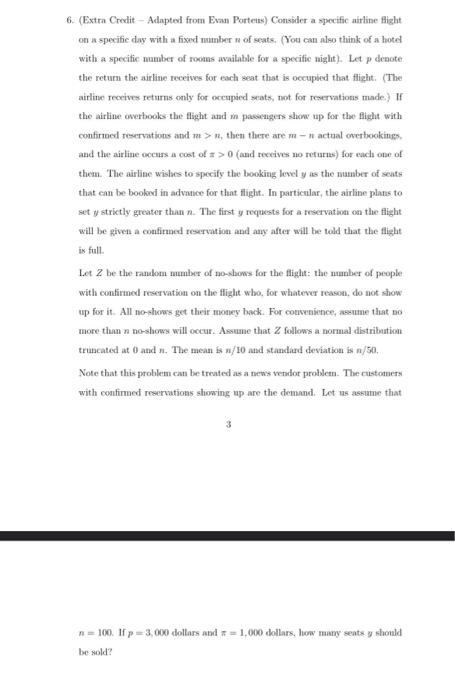
6. (Extra Credit - Adapted from Evan Porteus) Consider a specific airline flight
on a specific day with a fixed number n of seats. (You can also think of a hotel
with a specific number of rooms available for a specific night). Let p denote
the return the airline receives for each seat that is occupied that flight. (The
airline receives returns only for occupied seats, not for reservations made.) If
the airline overbooks the flight and m passengers show up for the flight with
confirmed reservations and m > n, then there are m - n actual overbookings,
and the airline occurs a cost of 1 > 0 (and receives no returns) for each one of
them. The airline wishes to specify the booking level y as the number of seats
that can be booked in advance for that flight. In particular, the airline plans to
set y strictly greater than n. The first y requests for a reservation on the flight
will be given a confirmed reservation and any after will be told that the flight
is full.
Let Z be the random number of no-shows for the flight: the number of people
with confirmed reservation on the flight who, for whatever reason, do not show
up for it. All no-shows get their money back. For convenience, assume that no
more than n no-shows will occur. Assume that Z follows a normal distribution
truncated at 0 and n. The mean is n/10 and standard deviation is n/50.
Note that this problem can be treated as a news vendor problem. The customers
with confirmed reservations showing up are the demand. Let us assume that
n = 100. If p = 3, 000 dollars and 7 = 1,000 dollars, how many seats y should
be sold?
Step by Step Solution
There are 3 Steps involved in it
1 Expert Approved Answer
Step: 1 Unlock

Question Has Been Solved by an Expert!
Get step-by-step solutions from verified subject matter experts
Step: 2 Unlock
Step: 3 Unlock
 Study Help