







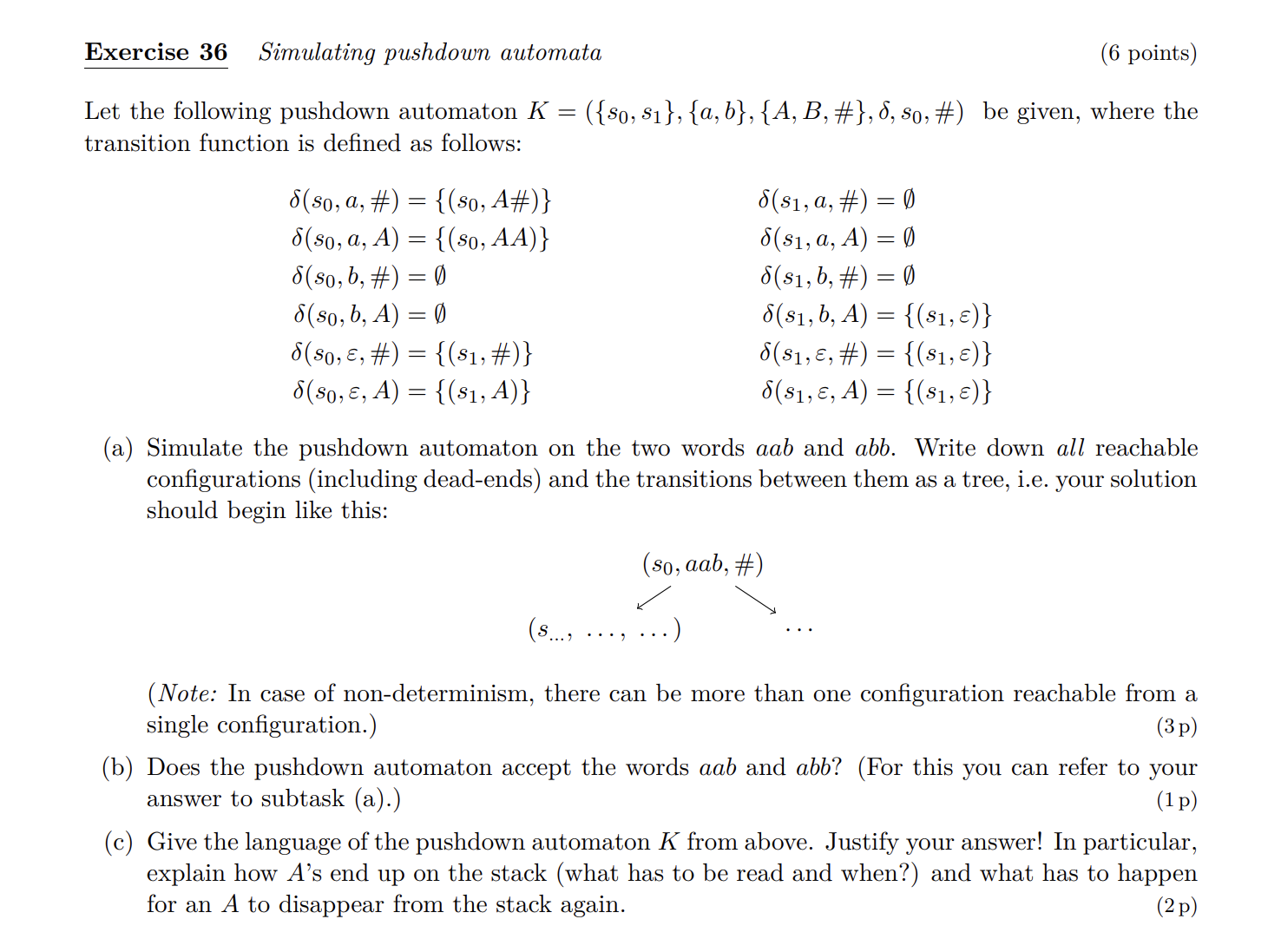
Question: ( 6 points ) Let the following pushdown automaton K = ( { s 0 , s 1 } , { a , b }
points
Let the following pushdown automaton ## be given, where the
transition function is defined as follows:
##
#
##
#
#
#
a Simulate the pushdown automaton on the two words aab and abb. Write down all reachable
configurations including deadends and the transitions between them as a tree, ie your solution
should begin like this:
Note: In case of nondeterminism, there can be more than one configuration reachable from a
single configuration.
b Does the pushdown automaton accept the words aab and abb For this you can refer to your
answer to subtask a
c Give the language of the pushdown automaton from above. Justify your answer! In particular,
explain how As end up on the stack what has to be read and when? and what has to happen
for an to disappear from the stack again.
Step by Step Solution
There are 3 Steps involved in it
1 Expert Approved Answer
Step: 1 Unlock

Question Has Been Solved by an Expert!
Get step-by-step solutions from verified subject matter experts
Step: 2 Unlock
Step: 3 Unlock
 Study Help