







Question: 6. Using the digital balance, weigh the empty bottle and write this weight in grams. 7. Fill the plastic bottle with water and re-weigh it
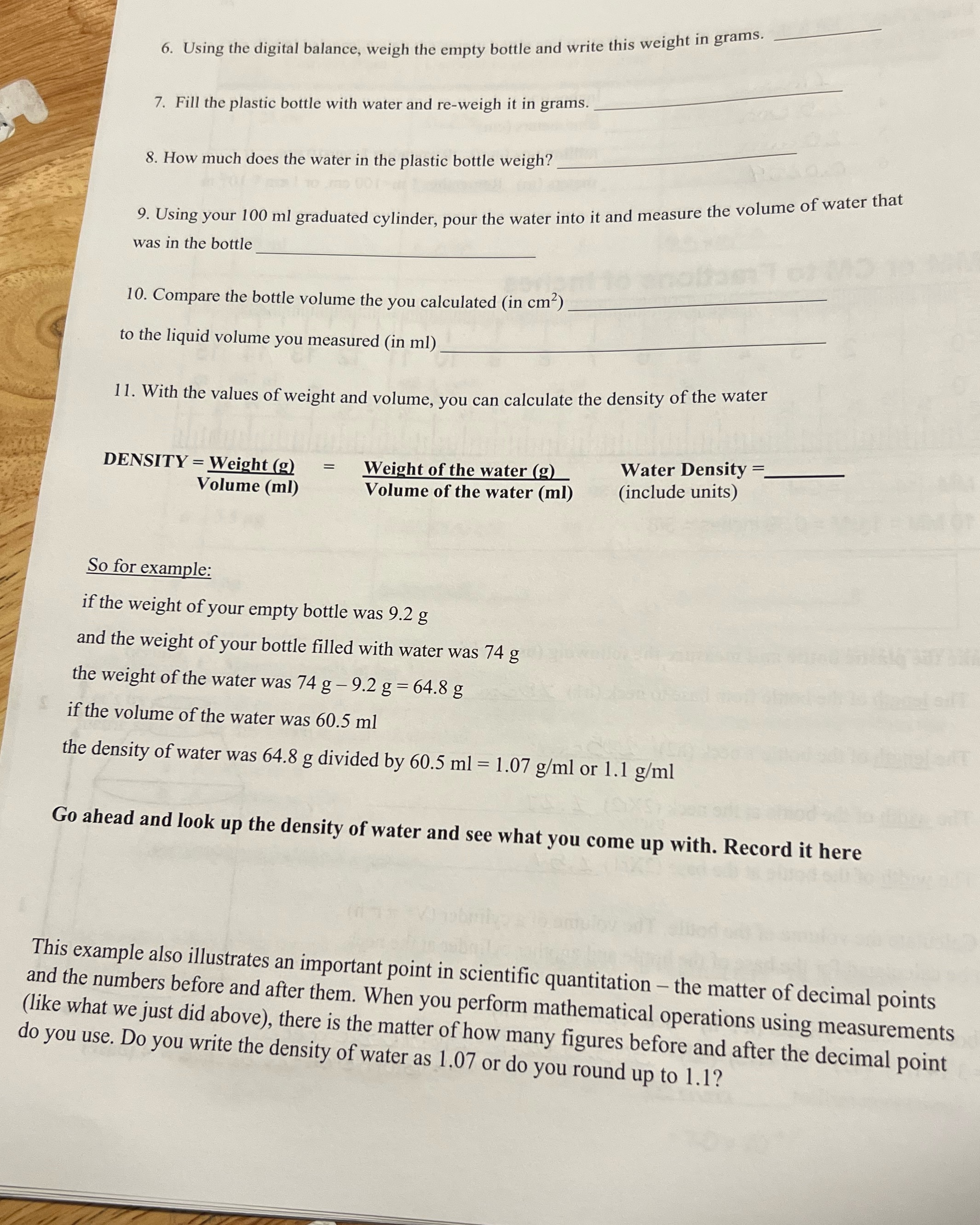
6. Using the digital balance, weigh the empty bottle and write this weight in grams. 7. Fill the plastic bottle with water and re-weigh it in grams. 8. How much does the water in the plastic bottle weigh? 9. Using your 100 ml graduated cylinder, pour the water into it and measure the volume of water that was in the bottle 10. Compare the bottle volume the you calculated (in cm?) to the liquid volume you measured (in ml) 1 1. With the values of weight and volume, you can calculate the density of the water DENSITY = Weight (g) = Weight of the water (g) Water Density = Volume (ml) Volume of the water (ml) (include units) So for example: if the weight of your empty bottle was 9.2 g and the weight of your bottle filled with water was 74 g the weight of the water was 74 g - 9.2 g = 64.8 g if the volume of the water was 60.5 ml the density of water was 64.8 g divided by 60.5 ml = 1.07 g/ml or 1.1 g/ml Go ahead and look up the density of water and see what you come up with. Record it here This example also illustrates an important point in scientific quantitative matter of decimal points and the numbers before and after them. When you perform mathematical operations using measurements (like what we just did above), there is the matter of how many figures before and after the decimal point do you use. Do you write the density of water as 1.07 or do you round up to
Step by Step Solution
There are 3 Steps involved in it

Get step-by-step solutions from verified subject matter experts
 Study Help