







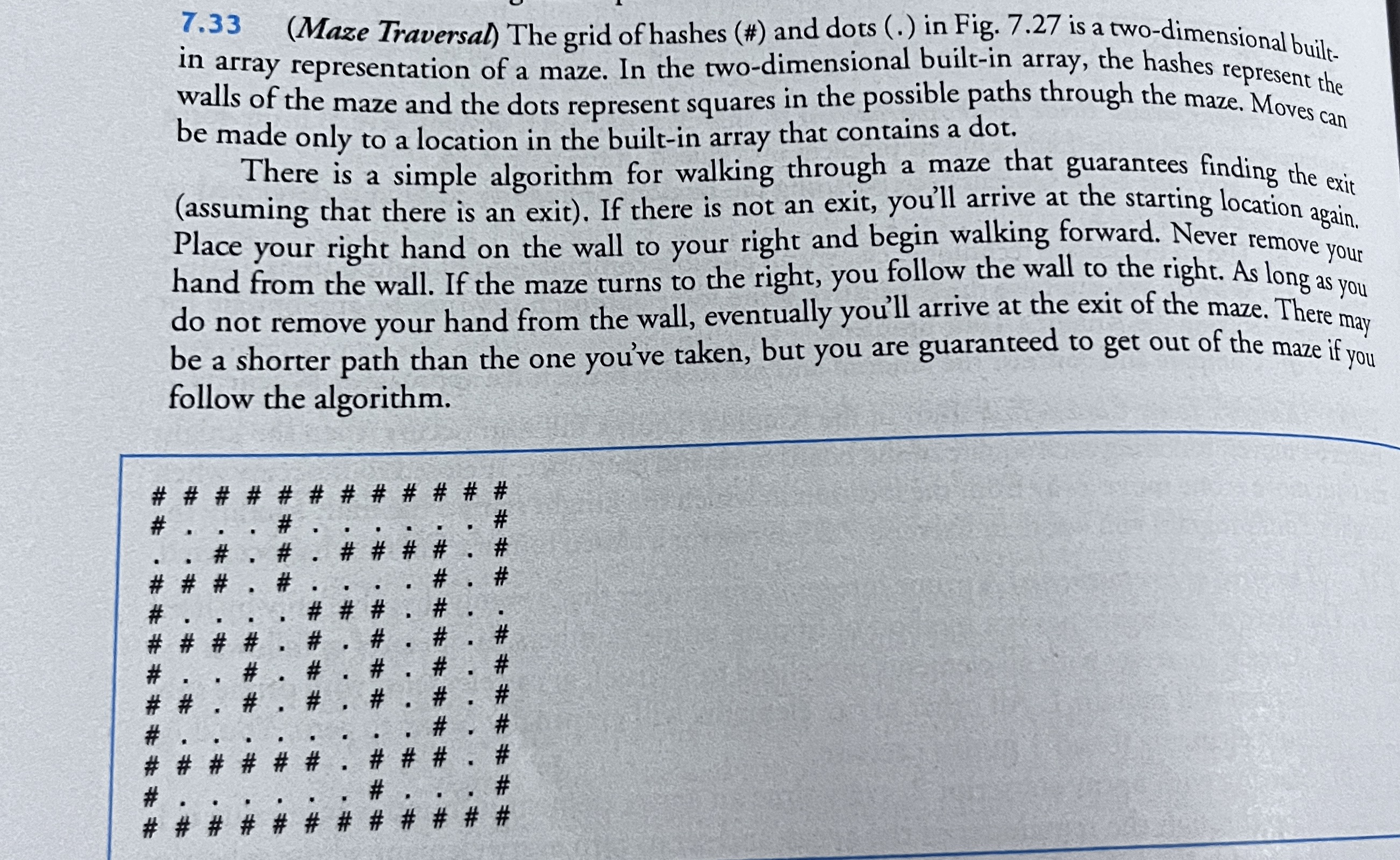
Question: 7 . 3 3 ( Maze Traversal ) The grid of hashes ( # ) and dots ( . ) in Fig. 7 . 2
Maze Traversal The grid of hashes # and dots in Fig. is a twodimensional built
in array representation of a maze. In the twodimensional builtin array, the hashes represent the
walls of the maze and the dots represent squares in the possible paths through the maze. Moves can
be made only to a location in the builtin array that contains a dot.
There is a simple algorithm for walking through a maze that guarantees finding the exit
assuming that there is an exit If there is not an exit, you'll arrive at the starting location again,
Place your right hand on the wall to your right and begin walking forward. Never remove your
hand from the wall. If the maze turns to the right, you follow the wall to the right. As long as you
do not remove your hand from the wall, eventually you'll arrive at the exit of the maze. There may
be a shorter path than the one you've taken, but you are guaranteed to get out of the maze if you
follow the algorithm.
Do not solve this project with recursion. Instead, follow the righthand rule as described in the text and below.
Program a rat your maze runner to have a direction: up right, down, and left can be coded as its forward direction. Based on which of the four directions, it should then try to go right relative to its forward direction. Eg if facing up then step right, if facing right then step down, facing down then left, etc. But in the case of facing up if you can't go right, then try to go forward. If not, try going left, otherwise step backward which you can always do If you successfully take a step in that direction, change the direction for the next iteration. You may backtrack, of course, as you never become blocked. As you step forward, change the. to ; if you backtrack, then change the to Of course, don't go through a wall # Print the matrixmaze at each step. Stop when the rat finds the exit. There is a lot of similar code cases but it is not easy to abstract to a function. so you don't have to try. code in C please
Step by Step Solution
There are 3 Steps involved in it
1 Expert Approved Answer
Step: 1 Unlock

Question Has Been Solved by an Expert!
Get step-by-step solutions from verified subject matter experts
Step: 2 Unlock
Step: 3 Unlock
 Study Help