





Question: 7. Challenges of applying the line drawing techniques include: A. What one decides in one case would remain confined to that particular case. B. The
7. Challenges of applying the line drawing
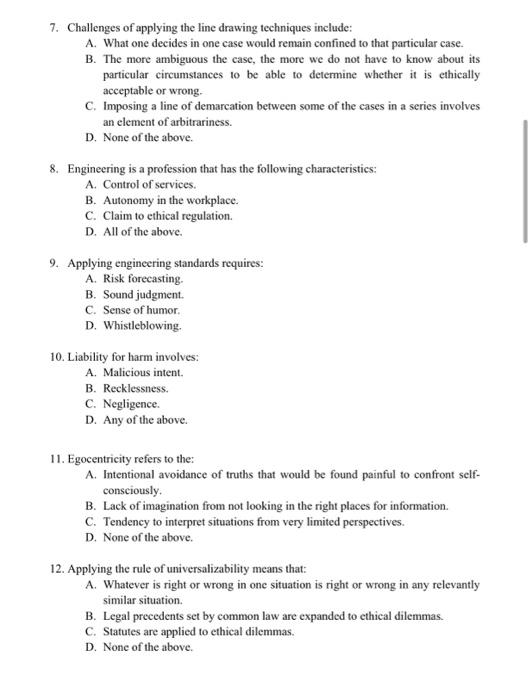
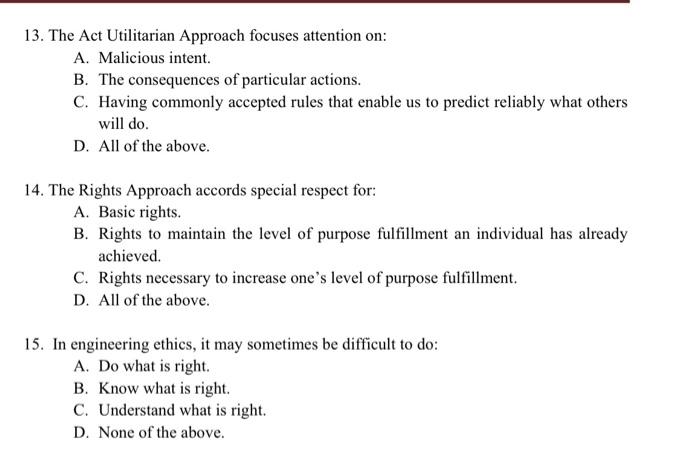
7. Challenges of applying the line drawing techniques include: A. What one decides in one case would remain confined to that particular case. B. The more ambiguous the case, the more we do not have to know about its particular circumstances to be able to determine whether it is ethically acceptable or wrong. C. Imposing a line of demarcation between some of the cases in a series involves an element of arbitrariness. D. None of the above. 8. Engineering is a profession that has the following characteristics: A. Control of services B. Autonomy in the workplace. C. Claim to ethical regulation D. All of the above. 9. Applying engineering standards requires: A. Risk forecasting B. Sound judgment. C. Sense of humor. D. Whistleblowing. 10. Liability for harm involves: A. Malicious intent. B. Recklessness. C. Negligence D. Any of the above. 11. Egocentricity refers to the A. Intentional avoidance of truths that would be found painful to confront self- consciously B. Lack of imagination from not looking in the right places for information C. Tendency to interpret situations from very limited perspectives. D. None of the above. 12. Applying the rule of universalizability means that: A. Whatever is right or wrong in one situation is right or wrong in any relevantly similar situation B. Legal precedents set by common law are expanded to ethical dilemmas. C. Statutes are applied to ethical dilemmas. D. None of the above. 13. The Act Utilitarian Approach focuses attention on: A. Malicious intent. B. The consequences of particular actions. C. Having commonly accepted rules that enable us to predict reliably what others will do. D. All of the above. 14. The Rights Approach accords special respect for: A. Basic rights. B. Rights to maintain the level of purpose fulfillment an individual has already achieved. C. Rights necessary to increase one's level of purpose fulfillment. D. All of the above. 15. In engineering ethics, it may sometimes be difficult to do: A. Do what is right B. Know what is right. C. Understand what is right. D. None of the above

Step by Step Solution

There are 3 Steps involved in it

1 Expert Approved Answer
Step: 1 Unlock blur-text-image

Question Has Been Solved by an Expert!

Get step-by-step solutions from verified subject matter experts

Step: 2 Unlock
Step: 3 Unlock

Students Have Also Explored These Related General Management Questions!