







Question: 7. Consider the following statements. QueueClass queue new QueueClass(); IntElement x = new IntElement(); IntElement y new IntElement(); int num; What is output by
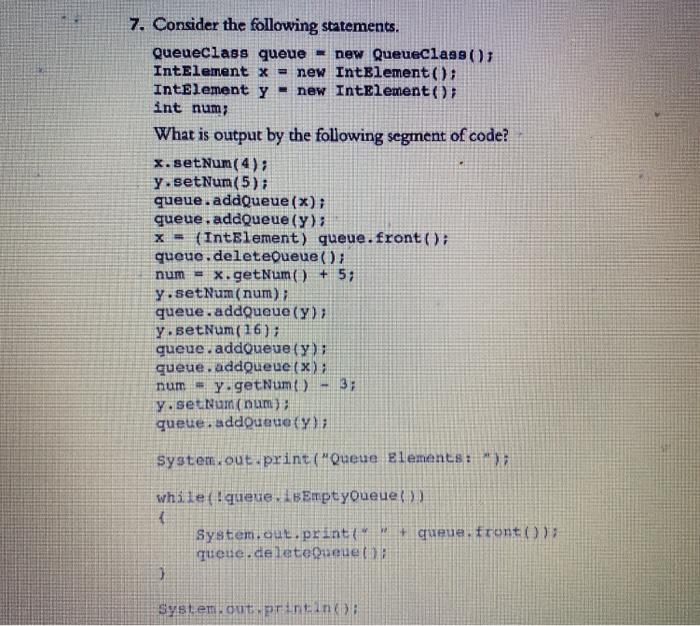
7. Consider the following statements. QueueClass queue new QueueClass(); IntElement x = new IntElement(); IntElement y new IntElement(); int num; What is output by the following segment of code? x.setNum (4); y.setNum (5); queue.addQueue (x); queue.addQueue (y); x = (IntElement) queue.front (); queue.deleteQueue (); num= x.getNum() +5; y.setNum (num); queue.addQueue (y); y.setNum (16); queue.addQueue (y); queue.addQueue (x); num y.getNum() - y.setNum(num); queue.addQueue (y); 3; System.out.print("Queue Elements: "); while (!queue.IsEmptyQueue ()) 4 W System.out.print(" +queue.front()); queue.deleteQueue (); System.out.printin();
Step by Step Solution
There are 3 Steps involved in it
provided seems to be related to a queue data structure and its operations Heres a breakdown of the code and the potential output Code Breakdown Queueclass queue new QueueClass This line creates a new ... View full answer

Get step-by-step solutions from verified subject matter experts
 Study Help