



Question: (7 pts total) When we use the Nernst equation to predict equilibrium values, we use the original ion concentrations. Why is a correction not needed
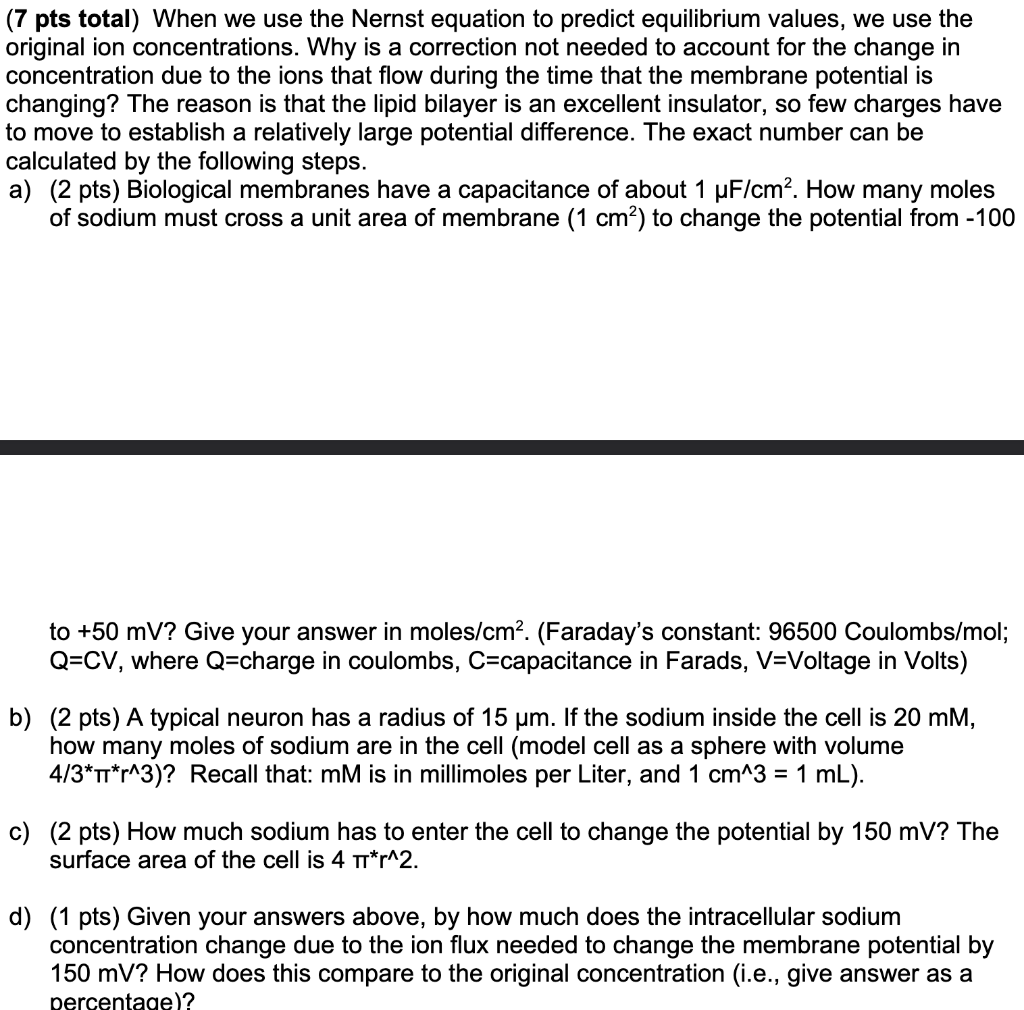
(7 pts total) When we use the Nernst equation to predict equilibrium values, we use the original ion concentrations. Why is a correction not needed to account for the change in concentration due to the ions that flow during the time that the membrane potential is changing? The reason is that the lipid bilayer is an excellent insulator, so few charges have to move to establish a relatively large potential difference. The exact number can be calculated by the following steps. a) (2 pts) Biological membranes have a capacitance of about 1 uF/cm. How many moles of sodium must cross a unit area of membrane (1 cm) to change the potential from - 100 to +50 mV? Give your answer in moles/cm. (Faraday's constant: 96500 Coulombs/mol; Q=CV, where Q=charge in coulombs, C=capacitance in Farads, V=Voltage in Volts) b) (2 pts) A typical neuron has a radius of 15 um. If the sodium inside the cell is 20 mM, how many moles of sodium are in the cell (model cell as a sphere with volume 4/3*T*r^3)? Recall that: mM is in millimoles per Liter, and 1 cm^3 = 1 mL). c) (2 pts) How much sodium has to enter the cell to change the potential by 150 mV? The surface area of the cell is 4 *r^2. d) (1 pts) Given your answers above, by how much does the intracellular sodium concentration change due to the ion flux needed to change the membrane potential by 150 mV? How does this compare to the original concentration (i.e., give answer as a percentage)? (7 pts total) When we use the Nernst equation to predict equilibrium values, we use the original ion concentrations. Why is a correction not needed to account for the change in concentration due to the ions that flow during the time that the membrane potential is changing? The reason is that the lipid bilayer is an excellent insulator, so few charges have to move to establish a relatively large potential difference. The exact number can be calculated by the following steps. a) (2 pts) Biological membranes have a capacitance of about 1 uF/cm. How many moles of sodium must cross a unit area of membrane (1 cm) to change the potential from - 100 to +50 mV? Give your answer in moles/cm. (Faraday's constant: 96500 Coulombs/mol; Q=CV, where Q=charge in coulombs, C=capacitance in Farads, V=Voltage in Volts) b) (2 pts) A typical neuron has a radius of 15 um. If the sodium inside the cell is 20 mM, how many moles of sodium are in the cell (model cell as a sphere with volume 4/3*T*r^3)? Recall that: mM is in millimoles per Liter, and 1 cm^3 = 1 mL). c) (2 pts) How much sodium has to enter the cell to change the potential by 150 mV? The surface area of the cell is 4 *r^2. d) (1 pts) Given your answers above, by how much does the intracellular sodium concentration change due to the ion flux needed to change the membrane potential by 150 mV? How does this compare to the original concentration (i.e., give answer as a percentage)
Step by Step Solution
There are 3 Steps involved in it

Get step-by-step solutions from verified subject matter experts