







Question: 7. Question: It is known that driving can be difficult in regions where winter conditions involve snow-covered roads. For cars equipped with all-season tires traveling
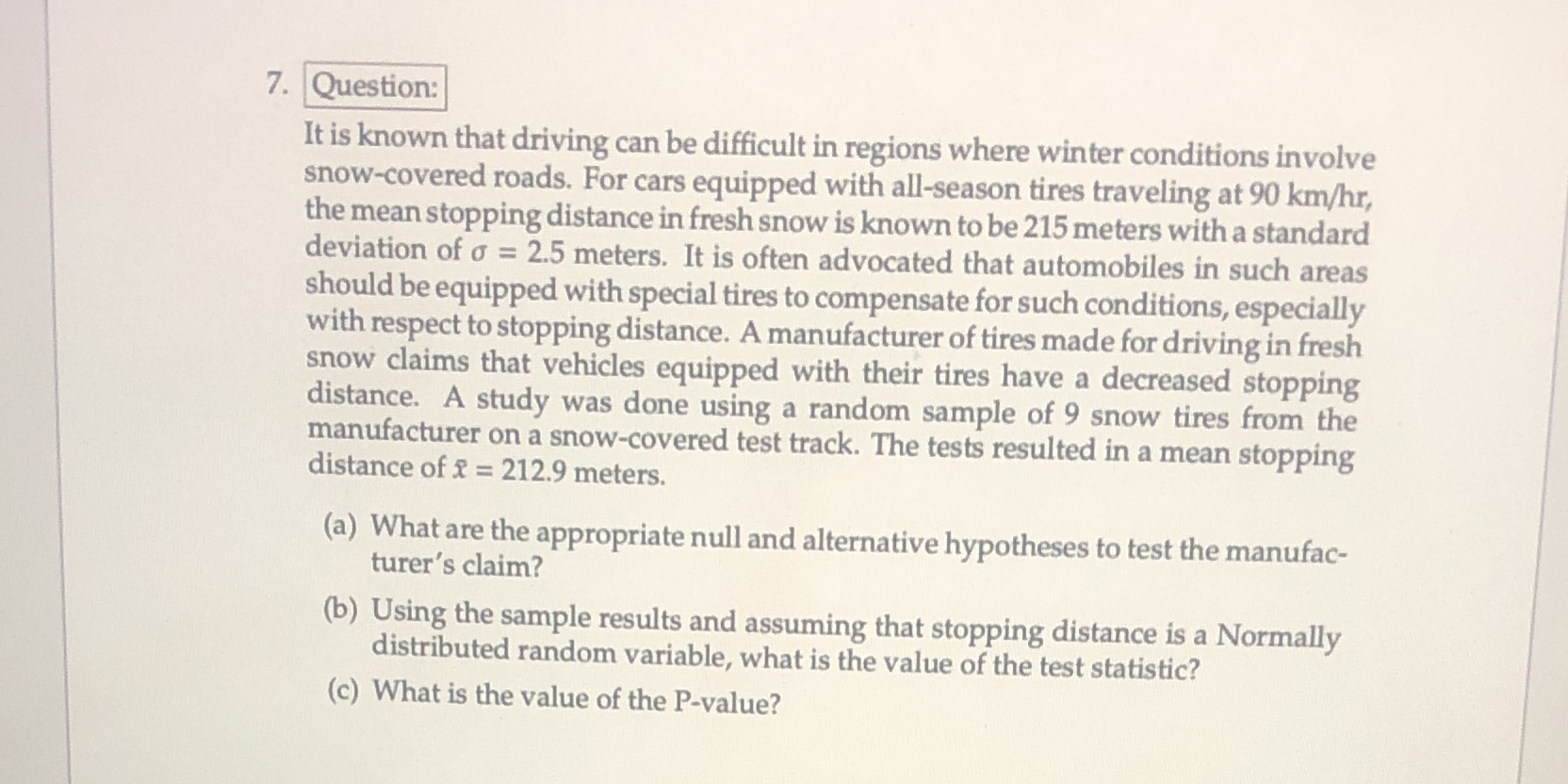
7. Question: It is known that driving can be difficult in regions where winter conditions involve snow-covered roads. For cars equipped with all-season tires traveling at 90 km/hr, the mean stopping distance in fresh snow is known to be 215 meters with a standard deviation of o = 2.5 meters. It is often advocated that automobiles in such areas should be equipped with special tires to compensate for such conditions, especially with respect to stopping distance. A manufacturer of tires made for driving in fresh snow claims that vehicles equipped with their tires have a decreased stopping distance. A study was done using a random sample of 9 snow tires from the manufacturer on a snow-covered test track. The tests resulted in a mean stopping distance of & = 212.9 meters. (a) What are the appropriate null and alternative hypotheses to test the manufac turer's claim? (b) Using the sample results and assuming that stopping distance is a Normally distributed random variable, what is the value of the test statistic? (c) What is the value of the P-value
Step by Step Solution
There are 3 Steps involved in it

Get step-by-step solutions from verified subject matter experts
 Study Help