





Question: 7. Redo Example 4.1 using high-order interleaving instead of low-order interleaving. Here is example 4.1 EXAMPLE 4.1 Suppose we have a 128-word memory that is
7. Redo Example 4.1 using high-order interleaving
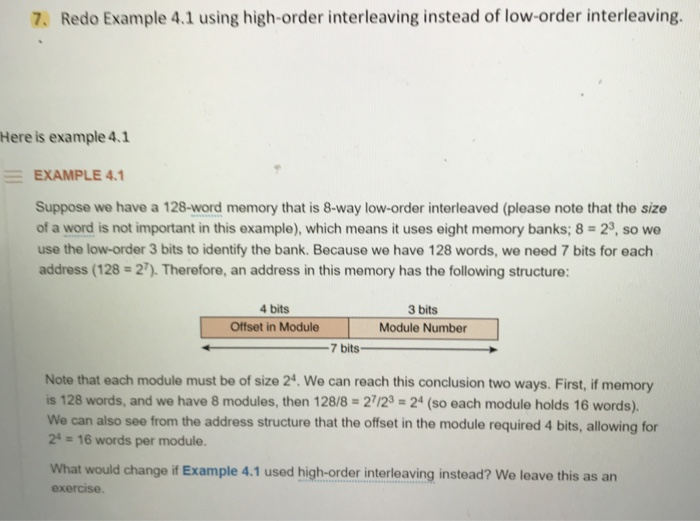
7. Redo Example 4.1 using high-order interleaving instead of low-order interleaving. Here is example 4.1 EXAMPLE 4.1 Suppose we have a 128-word memory that is 8-way low-order interleaved (please note that the size of a word is not important in this example), which means it uses eight memory banks; 8 = 23, so we use the low-order 3 bits to identify the bank. Because we have 128 words, we need 7 bits for each address (128 = 2). Therefore, an address in this memory has the following structure: 4 bits Offset in Module - 7 bits 3 bits Module Number Note that each module must be of size 24. We can reach this conclusion two ways. First, if memory is 128 words, and we have 8 modules, then 128/8 = 22/23 = 24 (so each module holds 16 words), We can also see from the address structure that the offset in the module required 4 bits, allowing for 24 = 16 words per module. What would change if Example 4.1 used high-order interleaving instead? We leave this as an exercise

Step by Step Solution

There are 3 Steps involved in it

1 Expert Approved Answer
Step: 1 Unlock blur-text-image

Question Has Been Solved by an Expert!

Get step-by-step solutions from verified subject matter experts

Step: 2 Unlock
Step: 3 Unlock

Students Have Also Explored These Related General Management Questions!