







Question: 7:18 a courses.kpu.ca Editing Assignment (5%) Using what you know about plain language, perfect paragraph construction, and basic grammar usage, re-create each of these writing
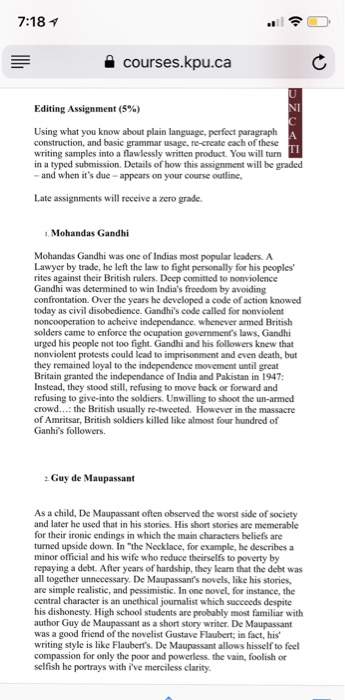
7:18 a courses.kpu.ca Editing Assignment (5%) Using what you know about plain language, perfect paragraph construction, and basic grammar usage, re-create each of these writing samples into a flawlessly written product. You will turn in a typed submission. Details of how this assignment will be graded and when it's due- appears on your course outline, Late assignments will receive a zero grade. 1. Mohandas Gandhi Mohandas Gandhi was one of Indias most popular leaders. A Lawyer by trade, he left the law to fight personally for his peoples' rites against their British rulers. Deep comitted to nonviolence Gandhi was determined to win India's freedom by avoiding confrontation. Over the years he developed a code of action knowed today as civil disobedience. Gandhi's code called for nonviolent noncooperation to acheive independance. whenever armed British solders came to enforce the ocupation governments laws, Gandhi urged his people not too fight. Gandhi and his followers knew that nonviolent protests could lead to imprisonment and even death, but they remained loyal to the independence movement until great Britain granted the independance of India and Pakistan in 1947: Instead, they stood still, refusing to move back or forward and refusing to give-into the soldiers. Unwilling to shoot the un-armed crowd....the British usually re-tweeted. However of Amritsar, British soldiers killed like almost four hundred of Ganhi's followers. in the massacre Guy de Maupassant As a child, De Maupassant often observed the worst side of society and later he used that in his stories. His short stories are memerable for their ironic endings in which the main characters beliefs are turned upside down. In "the Necklace, for example, he describes a minor official and his wife who reduce theirselfs to poverty by repaying a debt. After years of hardship, they learn that the debt was all together unnecessary. De Maupassant's novels, like his stories, are simple realistic, and pessimistic. In one novel, for instance, the central character is an unethical journalist which succeeds despite his dishonesty. High school students are probably most familiar with author Guy de Maupassant as a short story writer. De Maupassant was a good friend of the novelist Gustave Flaubert; in fact, his writing style is like Flaubert's. De Maupassant allows hisself to feel compassion for only the poor and powerless. the vain, foolish or selfish he portrays with i've merciless clarity
Step by Step Solution
There are 3 Steps involved in it

Get step-by-step solutions from verified subject matter experts
 Study Help