







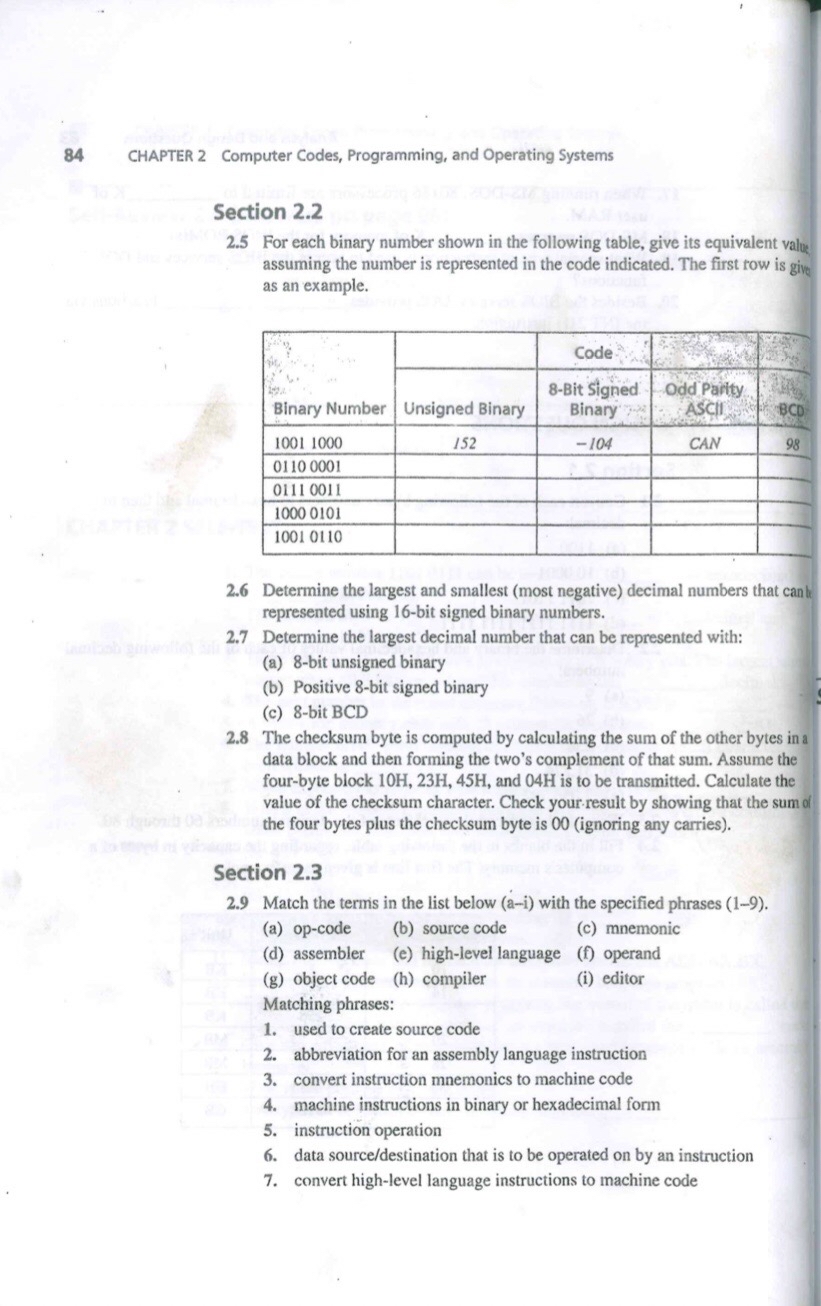
Question: 8 4 CHAPTER 2 Computer Codes, Programming, and Operating Systems Section 2 . 2 2 . 5 For each binary number shown in the following
CHAPTER Computer Codes, Programming, and Operating Systems
Section
For each binary number shown in the following table, give its equivalent value assuming the number is represented in the code indicated. The first row is give as an example.
tableBinary Number,Code,,Unsigned Binary,Bit Signed Binary,Odd Paity ASCII,BCDCAN,
Determine the largest and smallest most negative decimal numbers that cant represented using bit signed binary numbers.
Determine the largest decimal number that can be represented with:
abit unsigned binary
b Positive bit signed binary
cbit BCD
The checksum byte is computed by calculating the sum of the other bytes in a data block and then forming the two's complement of that sum. Assume the fourbyte block and H is to be transmitted. Calculate the value of the checksum character. Check your result by showing that the sum of the four bytes plus the checksum byte is ignoring any carries
Section
Match the terms in the list below ai with the specified phrases
a opcode
b source code
c mnemonic
d assembler
e highlevel language
f operand
g object code
h compiler
i editor
Matching phrases:
used to create source code
abbreviation for an assembly language instruction
convert instruction mnemonics to machine code
machine instructions in binary or hexadecimal form
instruction operation
data sourcedestination that is to be operated on by an instruction
convert highlevel language instructions to machine code
Step by Step Solution
There are 3 Steps involved in it
1 Expert Approved Answer
Step: 1 Unlock

Question Has Been Solved by an Expert!
Get step-by-step solutions from verified subject matter experts
Step: 2 Unlock
Step: 3 Unlock
 Study Help