



Question: 9 . 8 ) . The alloy is to be melted to the extent that 5 0 % of the specimen is liquid, the remainder
The alloy is to be melted to the extent that of the specimen is liquid, the remainder being the phase. This may be accomplished either by heating the alloy or changing its composition while holding the temperature constant.
a To what temperature must the specimen be heated?
b How much tin must be added to the specimen at to achieve this state?
A magnesiumlead alloy of mass kg consists of a solid phase that has a composition that is just slightly below the solubility limit at
a What mass of lead is in the alloy?
b If the alloy is heated to how much more lead may be dissolved in the phase without exceeding the solubility limit of this phase?
composition which, at equilibrium, consists of and phases having mass fractions and If so what will be the approximate temperature of the alloy? If such an alloy is not possible, explain why.
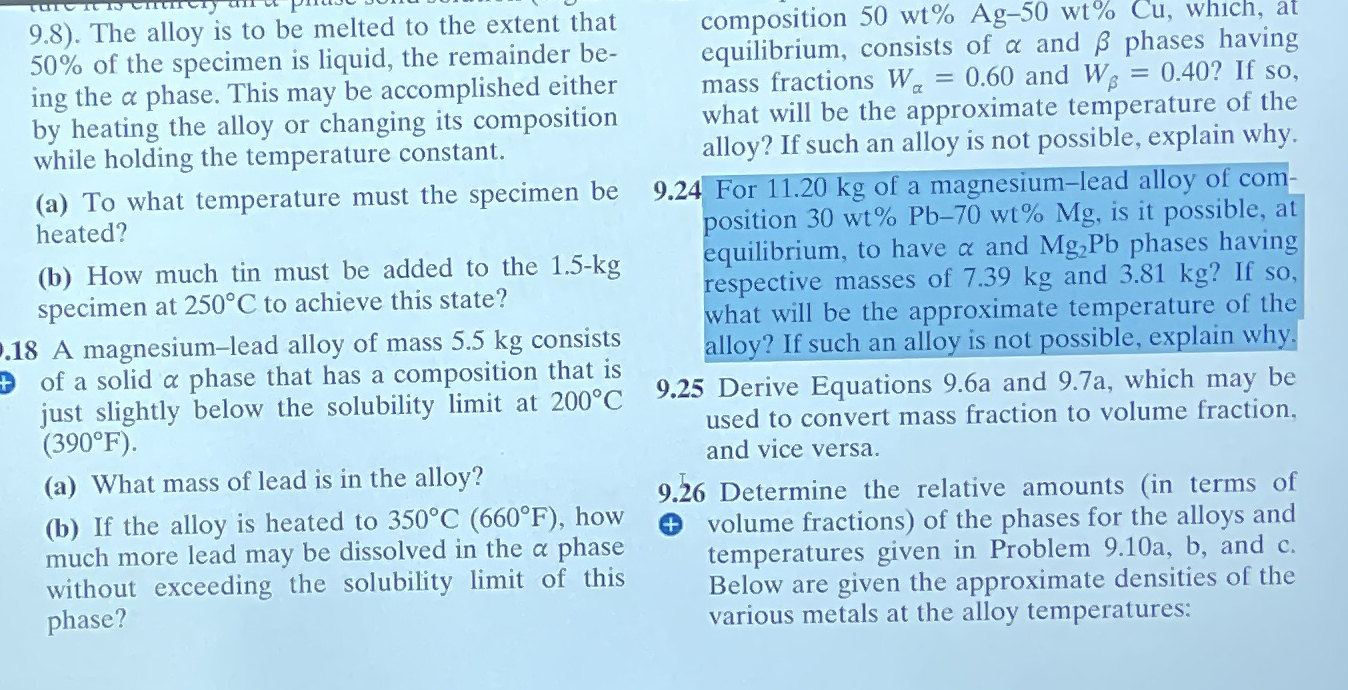
For kg of a magnesiumlead alloy of composition is it possible, at equilibrium, to have and phases having respective masses of kg and kg If so what will be the approximate temperature of the alloy? If such an alloy is not possible, explain why.
Derive Equations a and a which may be used to convert mass fraction to volume fraction, and vice versa.
Determine the relative amounts in terms of volume fractions of the phases for the alloys and temperatures given in Problem a b and c Below are given the approximate densities of t
he various metals at the alloy temperatures:
Do please the one that is highlighted blue. Thank you
Step by Step Solution
There are 3 Steps involved in it
1 Expert Approved Answer
Step: 1 Unlock

Question Has Been Solved by an Expert!
Get step-by-step solutions from verified subject matter experts
Step: 2 Unlock
Step: 3 Unlock