



Question: 9. Consider a monopolist that serves two geographically separated markets. Demand in the two markets and the firm's costs are as follows. The firm sets
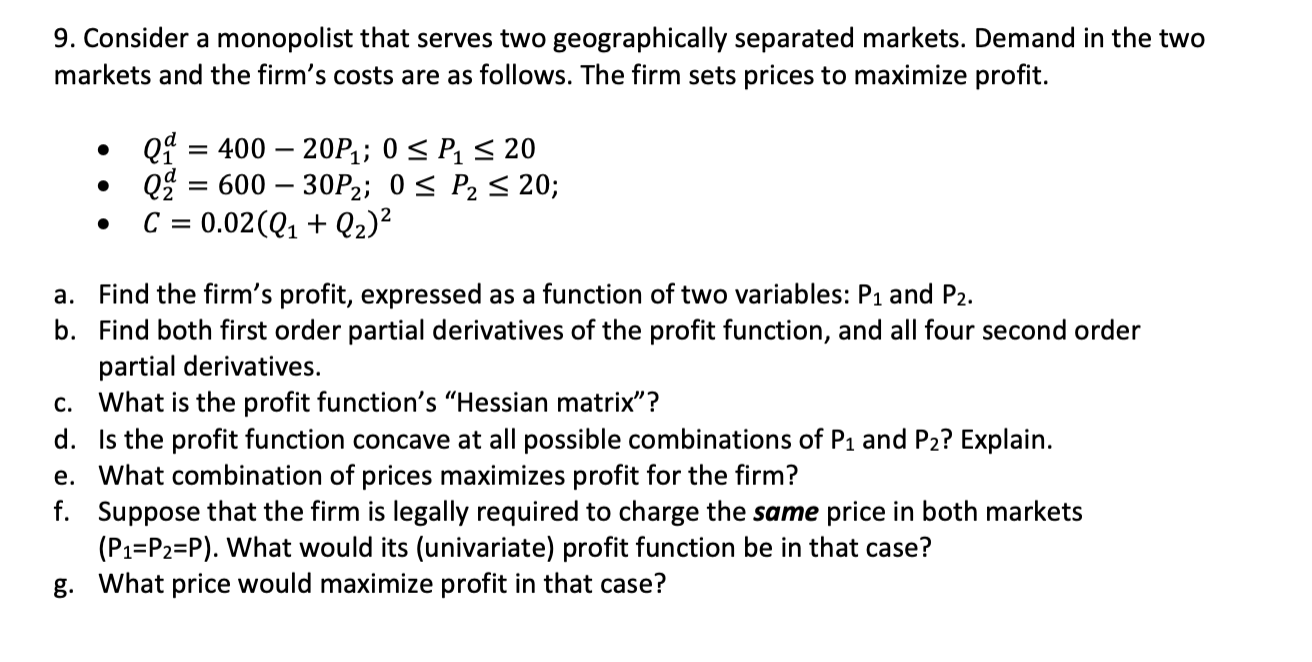
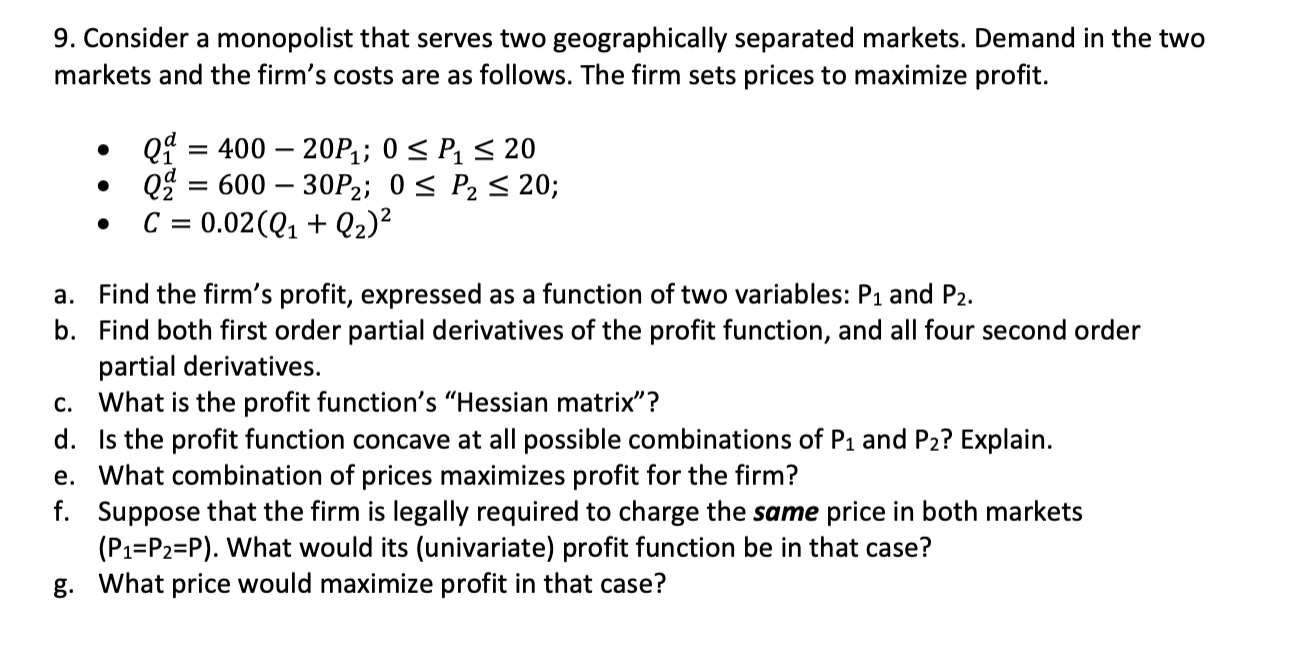
9. Consider a monopolist that serves two geographically separated markets. Demand in the two markets and the firm's costs are as follows. The firm sets prices to maximize profit. . Qf =40020P1; 05131520 . Q3 = sou30.02; 0 s P2 3 20; - C = 0-02(Ql + (22)2 Find the firm's profit, expressed as a function of two variables: P1 and P2. Find both first order partial derivatives of the profit function, and all four second order partial derivatives. What is the profit function's \"Hessian matrix\"? Is the profit function concave at all possible combinations of P1 and P2? Explain. What combination of prices maximizes profit for the firm? Suppose that the firm is legally required to charge the same price in both markets (P1=P2=P). What would its (univariate) profit function be in that case? g. What price would maximize profit in that case? Us\" 7"me
Step by Step Solution
There are 3 Steps involved in it

Get step-by-step solutions from verified subject matter experts