







Question: ( 9 points total ) Multinomial Logit Model A mode choice model was developed with the observable utility functions for auto, bus and train shown
points total Multinomial Logit Model
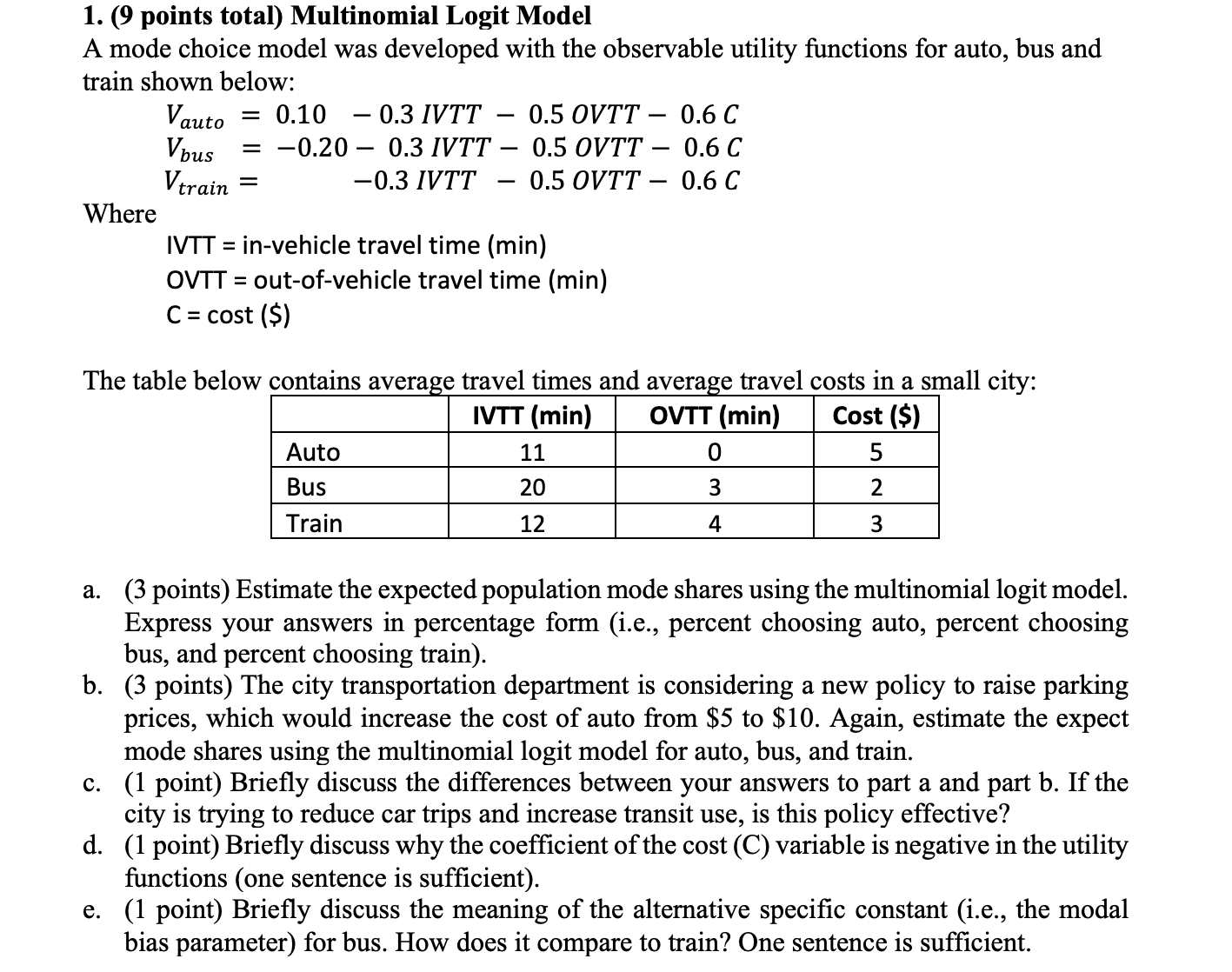
A mode choice model was developed with the observable utility functions for auto, bus and
train shown below:
IVTT OVTT
IVTT OVTT
IVTT OVTT
Where
IVTT vehicle travel time
OVTT outvehicle travel time
$
The table below contains average travel times and average travel costs in a small city:
a points Estimate the expected population mode shares using the multinomial logit model.
Express your answers in percentage form ie percent choosing auto, percent choosing
bus, and percent choosing train
b points The city transportation department is considering a new policy to raise parking
prices, which would increase the cost of auto from $ to $ Again, estimate the expect
mode shares using the multinomial logit model for auto, bus, and train.
c point Briefly discuss the differences between your answers to part a and part If the
city is trying to reduce car trips and increase transit use, is this policy effective?
d point Briefly discuss why the coefficient of the cost C variable is negative in the utility
functions one sentence is sufficient
e point Briefly discuss the meaning of the alternative specific constant ie the modal
bias parameter for bus. How does it compare to train? One sentence is sufficient points total Multinomial Logit Model
A mode choice model was developed with the observable utility functions for auto, bus and train shown below:
Vauto IVTT OVTT C
Vbus IVTT OVTT C
Vtrain IVTT OVTT C
Where
IVTT invehicle travel time min
OVTT outofvehicle travel time min
C cost $
The table below contains average travel times and average travel costs in a small city:
IVTT min OVTT min Cost $
Auto
Bus
Train
points Estimate the expected population mode shares using the multinomial logit model. Express your answers in percentage form ie percent choosing auto, percent choosing bus, and percent choosing train
points The city transportation department is considering a new policy to raise parking prices, which would increase the cost of auto from $ to $ Again, estimate the expect mode shares using the multinomial logit model for auto, bus, and train.
point Briefly discuss the differences between your answers to part a and part b If the city is trying to reduce car trips and increase transit use, is this policy effective?
point Briefly discuss why the coefficient of the cost C variable is negative in the utility functions one sentence is sufficient
point Briefly discuss the meaning of the alternative specific constant ie the modal bias parameter for bus. How does it compare to train? One sentence is sufficient.
Step by Step Solution
There are 3 Steps involved in it
1 Expert Approved Answer
Step: 1 Unlock

Question Has Been Solved by an Expert!
Get step-by-step solutions from verified subject matter experts
Step: 2 Unlock
Step: 3 Unlock
 Study Help