Question: 9-2a. Constitutional Law: The Fourth Amendment The Fourth Amendment to the Constitution prohibits unreasonable searches and seizures by the government. The government must first obtain
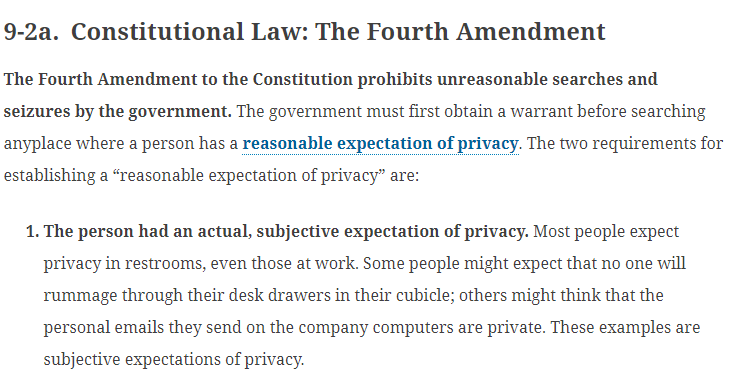
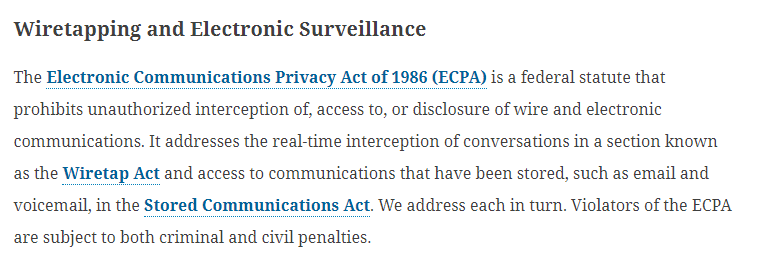
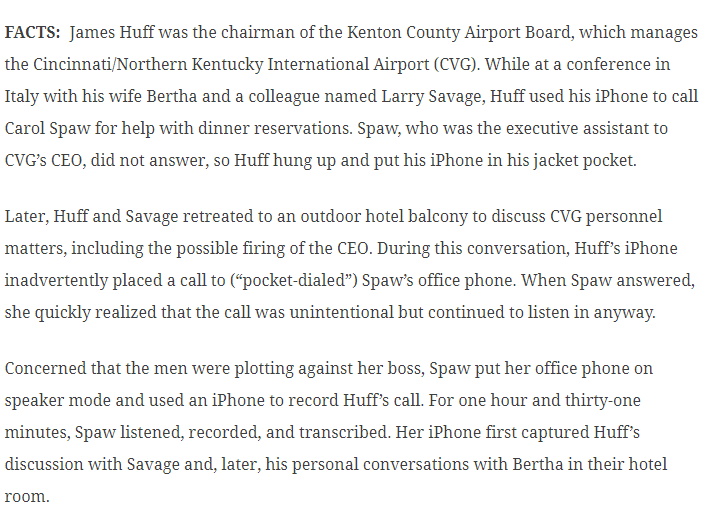
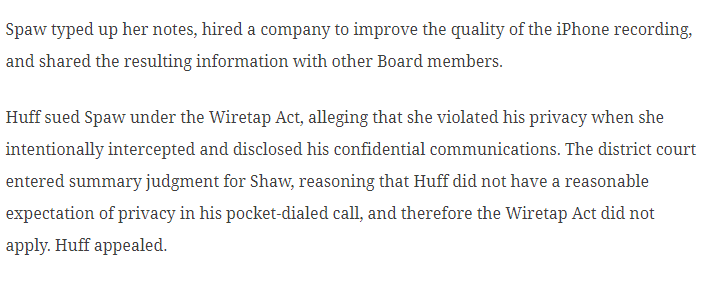
9-2a. Constitutional Law: The Fourth Amendment The Fourth Amendment to the Constitution prohibits unreasonable searches and seizures by the government. The government must first obtain a warrant before searching anyplace where a person has a reasonable expectation of privacy. The two requirements for establishing a "reasonable expectation of privacy" are: 1. The person had an actual, subjective expectation of privacy. Most people expect privacy in restrooms, even those at work. Some people might expect that no one will rummage through their desk drawers in their cubicle; others might think that the personal emails they send on the company computers are private. These examples are subjective expectations of privacy.Wiretapping and Electronic Surveillance The Electronic Communications Privacy Act of 1986 (ECPA) is a federal statute that prohibits unauthorized interception of, access to, or disclosure of wire and electronic communications. It addresses the real-time interception of conversations in a section known as the Wiretap Act and access to communications that have been stored, such as email and voicemail, in the Stored Communications Act. We address each in turn. Violators of the ECPA are subject to both criminal and civil penalties.FACTS: James Huff was the chairman of the Kenton County Airport Board, which manages the Cincinnati/Northern Kentucky International Airport (CVG). While at a conference in Italy with his wife Bertha and a colleague named Larry Savage, Huff used his iPhone to call Carol Spaw for help with dinner reservations. Spaw, who was the executive assistant to CVG's CEO, did not answer, so Huff hung up and put his iPhone in his jacket pocket. Later, Huff and Savage retreated to an outdoor hotel balcony to discuss CVG personnel matters, including the possible firing of the CEO. During this conversation, Huff's iPhone inadvertently placed a call to ("pocket-dialed") Spaw's office phone. When Spaw answered, she quickly realized that the call was unintentional but continued to listen in anyway. Concerned that the men were plotting against her boss, Spaw put her office phone on speaker mode and used an iphone to record Huff's call. For one hour and thirty-one minutes, Spaw listened, recorded, and transcribed. Her iPhone first captured Huff's discussion with Savage and, later, his personal conversations with Bertha in their hotel room.Spat-v typed up her notes, hired a company to improve the quality of the iPhone recording, and shared the resulting information with other Board members. Huff sued Spaw under the Wiretap Act, alleging that she violated his priva cv when she intentionally intercepted and disclosed his confidential communications. The district court entered summary judgment for Shaw, reasoning that Huff did not have a reasonable expectation of privacy in his pocketdialed call, and therefore the Wiretap Act did not applv. Huff appealed
Step by Step Solution
There are 3 Steps involved in it
1 Expert Approved Answer
Step: 1 Unlock
Question Has Been Solved by an Expert!
Get step-by-step solutions from verified subject matter experts
Step: 2 Unlock
Step: 3 Unlock
Students Have Also Explored These Related Law Questions!









 Study Help