







Question: 9.5 Hypothesis Testing for Proportions Using the p-Value (Z-test) Many investors and financial analysts believe the Dow Jones Industrial Average (DJIA) gives a good barometer
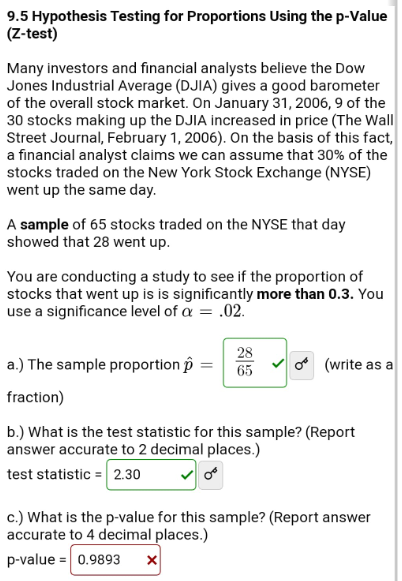
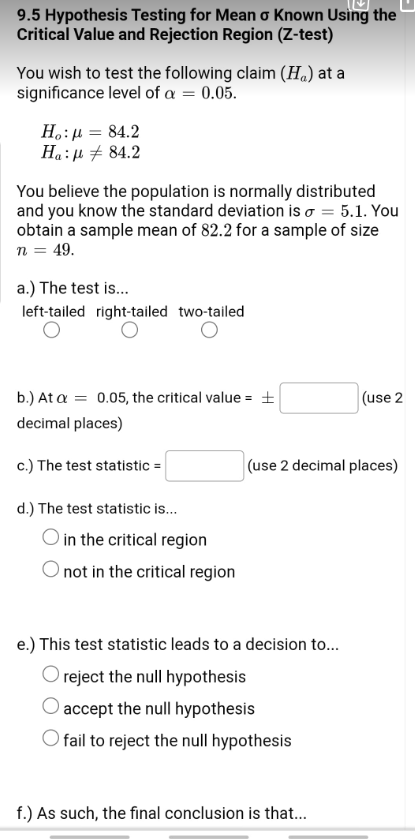
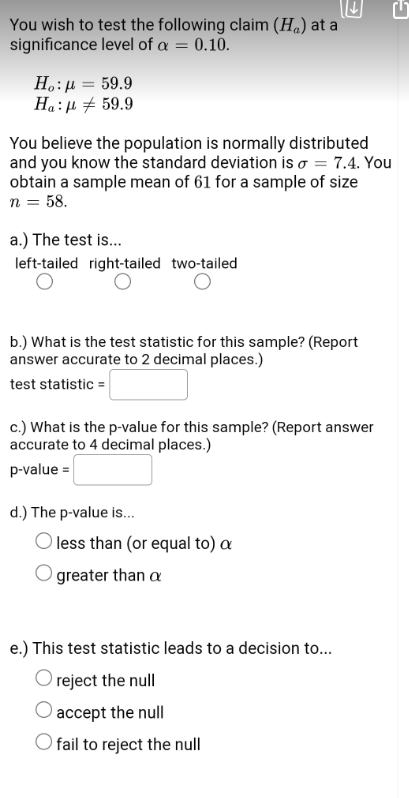
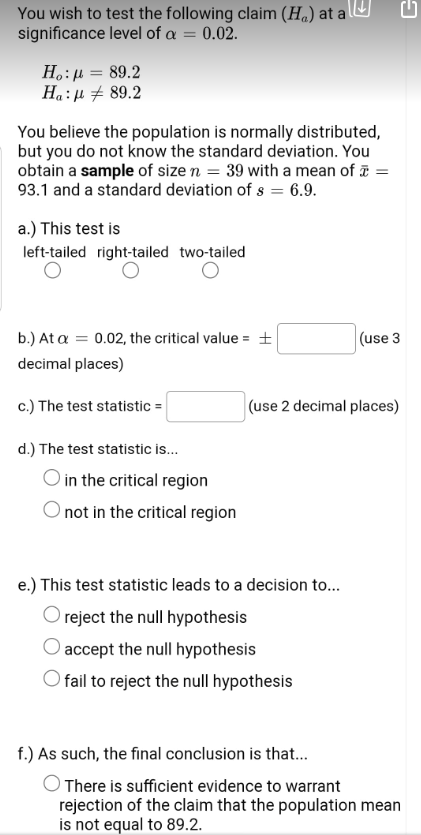
9.5 Hypothesis Testing for Proportions Using the p-Value (Z-test) Many investors and financial analysts believe the Dow Jones Industrial Average (DJIA) gives a good barometer of the overall stock market. On January 31, 2006, 9 of the 30 stocks making up the DJIA increased in price (The Wall Street Journal, February 1, 2006). On the basis of this fact, a financial analyst claims we can assume that 30% of the stocks traded on the New York Stock Exchange (NYSE) went up the same day. A sample of 65 stocks traded on the NYSE that day showed that 28 went up. You are conducting a study to see if the proportion of stocks that went up is is significantly more than 0.3. You use a significance level of o = .02. 28 a.) The sample proportion p = 65 (write as a fraction) b.) What is the test statistic for this sample? (Report answer accurate to 2 decimal places.) test statistic = 2.30 c.) What is the p-value for this sample? (Report answer accurate to 4 decimal places.) p-value = 0.9893 X9.5 Hypothesis Testing for Mean o Known Using the Critical Value and Rejection Region (Z-test) You wish to test the following claim (H.) at a significance level of a = 0.05. Ho: u = 84.2 Ha: u # 84.2 You believe the population is normally distributed and you know the standard deviation is o = 5.1. You obtain a sample mean of 82.2 for a sample of size n = 49. a.) The test is... left-tailed right-tailed two-tailed O O O b.) At a = 0.05, the critical value = use 2 decimal places) c.) The test statistic = (use 2 decimal places) d.) The test statistic is... O in the critical region not in the critical region e.) This test statistic leads to a decision to... O reject the null hypothesis O accept the null hypothesis O fail to reject the null hypothesis f.) As such, the final conclusion is that...You wish to test the following claim (H.) at a significance level of a = 0.10. Ho: u = 59.9 Ha: u # 59.9 You believe the population is normally distributed and you know the standard deviation is o = 7.4. You obtain a sample mean of 61 for a sample of size n = 58. a.) The test is... left-tailed right-tailed two-tailed b.) What is the test statistic for this sample? (Report answer accurate to 2 decimal places.) test statistic = c.) What is the p-value for this sample? (Report answer accurate to 4 decimal places.) p-value = d.) The p-value is... O less than (or equal to) a O greater than a e.) This test statistic leads to a decision to... O reject the null O accept the null O fail to reject the nullYou wish to test the following claim (H.) at al(#] significance level of a = 0.02. Ho: u = 89.2 Ha: u + 89.2 You believe the population is normally distributed, but you do not know the standard deviation. You obtain a sample of size n = 39 with a mean of T = 93.1 and a standard deviation of s = 6.9. a.) This test is left-tailed right-tailed two-tailed C b.) At a = 0.02, the critical value = use 3 decimal places) c.) The test statistic = (use 2 decimal places) d.) The test statistic is... O in the critical region O not in the critical region e.) This test statistic leads to a decision to... O reject the null hypothesis O accept the null hypothesis O fail to reject the null hypothesis f.) As such, the final conclusion is that... O There is sufficient evidence to warrant rejection of the claim that the population mean is not equal to 89.2
Step by Step Solution
There are 3 Steps involved in it

Get step-by-step solutions from verified subject matter experts
 Study Help