







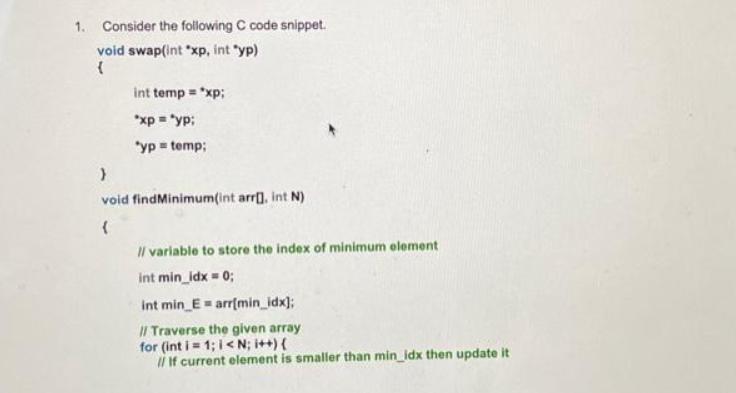
Question: a. [70 points] Implement the C code snippet in RISC-V assembly language. Use s0-s2 to hold the variable i, j, and min_idx in the
![a. [70 points] Implement the C code snippet in RISC-V assembly language. Use s0-s2 to hold the variable i, j,](https://dsd5zvtm8ll6.cloudfront.net/si.experts.images/questions/2023/09/65154afd7d06b_1695894261168.jpg)
![if (arr[i] < min_E) { min_idx = i; } return min_idx; min E = arr[min_idx]; } /* Function to sort an array](https://dsd5zvtm8ll6.cloudfront.net/si.experts.images/questions/2023/09/65154b1ad8e34_1695894291330.jpg)
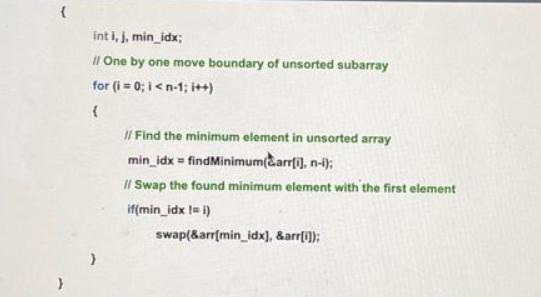
a. [70 points] Implement the C code snippet in RISC-V assembly language. Use s0-s2 to hold the variable i, j, and min_idx in the function selectionSort. Be sure to handle the stack pointer appropriately. The array is stored on the stack of the selection Sortfunction. Clearly comment your comments b. [30 points] Assume that the selectionSort is the function called. Draw the status of the stack before calling selectionSort and during each function call. Indicate stack addresses and names of registers and variables stored on the stack; mark the location of sp; and clearly mark each stack frame. Assume the sp starts at 0x8000. 1. Consider the following C code snippet. void swap(int *xp, int "yp) int temp = *xp; *xp = "yp: "yp = temp; } void findMinimum(int arr], int N) ( Il variable to store the index of minimum element int min_idx = 0; int min_E= arr[min_idx]; II Traverse the given array for (int i=1;i < N;i++) { IlIf current element is smaller than min_idx then update it if (arr[i] < min_E) { min_idx = i; } return min_idx; min E = arr[min_idx]; } /* Function to sort an array using selection sort"/ void selectionSort(int arr], int n) { int i, j, min_idx; II One by one move boundary of unsorted subarray for (i =0; i } int i, j, min_idx; Il One by one move boundary of unsorted subarray for (i=0; i
Step by Step Solution
There are 3 Steps involved in it
This question involves translating a C code snippet into RISCV assembly language and illustrating the stacks status before and during function calls Heres an introduction to provide context In this ex... View full answer

Get step-by-step solutions from verified subject matter experts
 Study Help