







Question: A battery charging indicator system needs to be designed using Moore sequential. Input to the system is charging current measured through a 4-bit analog
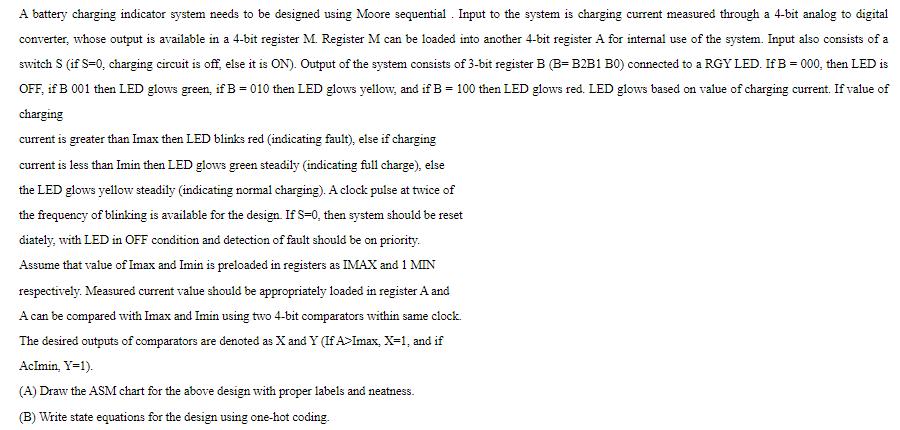
A battery charging indicator system needs to be designed using Moore sequential. Input to the system is charging current measured through a 4-bit analog to digital converter, whose output is available in a 4-bit register M. Register M can be loaded into another 4-bit register A for internal use of the system. Input also consists of a switch S (if S=0, charging circuit is off, else it is ON). Output of the system consists of 3-bit register B (B=B2B1 B0) connected to a RGY LED. If B = 000, then LED is OFF, if B 001 then LED glows green, if B = 010 then LED glows yellow, and if B = 100 then LED glows red. LED glows based on value of charging current. If value of charging current is greater than Imax then LED blinks red (indicating fault), else if charging current is less than Imin then LED glows green steadily (indicating full charge), else the LED glows yellow steadily (indicating normal charging). A clock pulse at twice of the frequency of blinking is available for the design. If S=0, then system should be reset diately, with LED in OFF condition and detection of fault should be on priority. Assume that value of Imax and Imin is preloaded in registers as IMAX and 1 MIN respectively. Measured current value should be appropriately loaded in register A and A can be compared with Imax and Imin using two 4-bit comparators within same clock. The desired outputs of comparators are denoted as X and Y (If A>Imax, X=1, and if Aclmin, Y=1). (A) Draw the ASM chart for the above design with proper labels and neatness. (B) Write state equations for the design using one-hot coding. A battery charging indicator system needs to be designed using Moore sequential. Input to the system is charging current measured through a 4-bit analog to digital converter, whose output is available in a 4-bit register M. Register M can be loaded into another 4-bit register A for internal use of the system. Input also consists of a switch S (if S=0, charging circuit is off, else it is ON). Output of the system consists of 3-bit register B (B=B2B1 B0) connected to a RGY LED. If B = 000, then LED is OFF, if B 001 then LED glows green, if B = 010 then LED glows yellow, and if B = 100 then LED glows red. LED glows based on value of charging current. If value of charging current is greater than Imax then LED blinks red (indicating fault), else if charging current is less than Imin then LED glows green steadily (indicating full charge), else the LED glows yellow steadily (indicating normal charging). A clock pulse at twice of the frequency of blinking is available for the design. If S=0, then system should be reset diately, with LED in OFF condition and detection of fault should be on priority. Assume that value of Imax and Imin is preloaded in registers as IMAX and 1 MIN respectively. Measured current value should be appropriately loaded in register A and A can be compared with Imax and Imin using two 4-bit comparators within same clock. The desired outputs of comparators are denoted as X and Y (If A>Imax, X=1, and if Aclmin, Y=1). (A) Draw the ASM chart for the above design with proper labels and neatness. (B) Write state equations for the design using one-hot coding.
Step by Step Solution
There are 3 Steps involved in it
Answer Explanation Now 1 Input Processing The 4bit charging current value from the analogue to digital converter is loaded into register M The switch ... View full answer

Get step-by-step solutions from verified subject matter experts
 Study Help