



Question: a. C. 13. For the Bronsted-Lowry acid-base reaction shown: HSO. HPO SO HPO. A conjugate Bronsted-Lowry acid-base pair is: HSO. (base) and SO: (acid) HPO
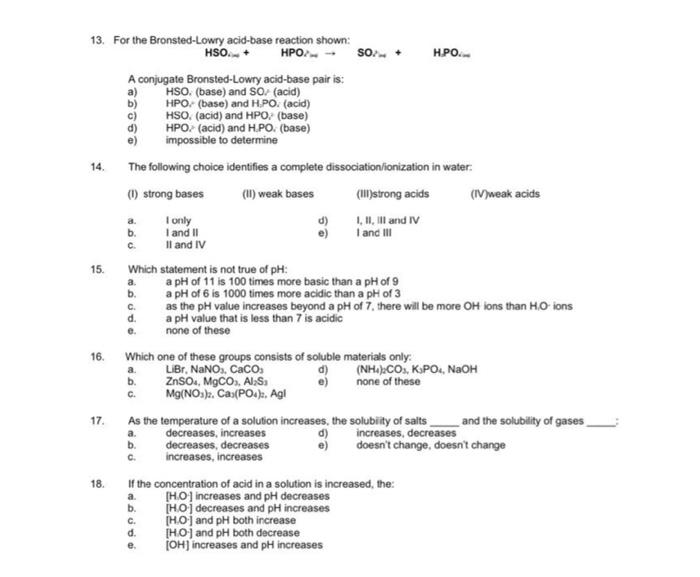
a. C. 13. For the Bronsted-Lowry acid-base reaction shown: HSO. HPO SO HPO. A conjugate Bronsted-Lowry acid-base pair is: HSO. (base) and SO: (acid) HPO (base) and H.PO, (acid) HSO (acid) and HPO (base) HPO. (acid) and H.PO. (base) e) impossible to determine 14. The following choice identifies a complete dissociation/ionization in water. (1) strong bases (II) weak bases (III)strong acids (IV)weak acids I only I, II and IV b. I and II I and III II and IV 15. Which statement is not true of pH: a. a pH of 11 is 100 times more basic than a pH of 9 b. a pH of 6 is 1000 times more acidic than a pH of 3 c. as the pH value increases beyond a pH of 7 there will be more OH ions than HO ions d. a pH value that is less than 7 is acidic none of these 16. Which one of these groups consists of soluble materials only a. LIBr, NaNO, Caco d) (NH4)2COS, K.PO., NaOH b. ZnSO, MgCO, AlS. none of these C. Mg(NO3)2. Cas(PO4)3. Agl 17. As the temperature of a solution increases the solubility of salts and the solubility of gases a. decreases, increases d) increases, decreases decreases, decreases doesn't change, doesn't change increases, increases 18 If the concentration of acid in a solution is increased, the: [H.O increases and pH decreases b. [HOdecreases and pH increases c. HO) and pH both increase d. [HO] and pH both decrease (OH) increases and pH increases e. b. c. a e
Step by Step Solution
There are 3 Steps involved in it

Get step-by-step solutions from verified subject matter experts