



Question: A chemostat is a continuous stirred tank bioreactor. Its dynamic behavior can be described by the following equations: dtdX=(S)XDXdtdS=D(SfS)Y(S)X X and S are the cell
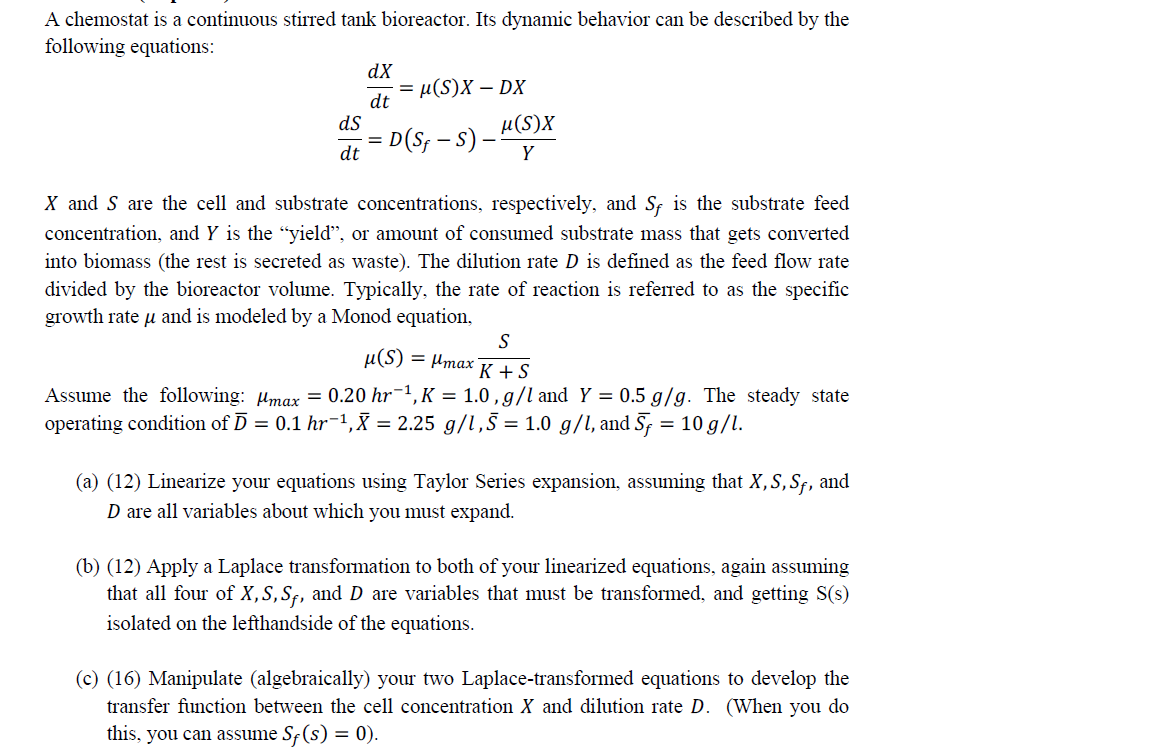
A chemostat is a continuous stirred tank bioreactor. Its dynamic behavior can be described by the following equations: dtdX=(S)XDXdtdS=D(SfS)Y(S)X X and S are the cell and substrate concentrations, respectively, and Sf is the substrate feed concentration, and Y is the "yield", or amount of consumed substrate mass that gets converted into biomass (the rest is secreted as waste). The dilution rate D is defined as the feed flow rate divided by the bioreactor volume. Typically, the rate of reaction is referred to as the specific growth rate and is modeled by a Monod equation, (S)=maxK+SS Assume the following: max=0.20hr1,K=1.0,g/l and Y=0.5g/g. The steady state operating condition of D=0.1hr1,X=2.25g/l,S=1.0g/l, and Sf=10g/l. (a) (12) Linearize your equations using Taylor Series expansion, assuming that X,S,Sf, and D are all variables about which you must expand. (b) (12) Apply a Laplace transformation to both of your linearized equations, again assuming that all four of X,S,Sf, and D are variables that must be transformed, and getting S(s) isolated on the lefthandside of the equations. (c) (16) Manipulate (algebraically) your two Laplace-transformed equations to develop the transfer function between the cell concentration X and dilution rate D. (When you do this, you can assume Sf(s)=0)
Step by Step Solution
There are 3 Steps involved in it

Get step-by-step solutions from verified subject matter experts