







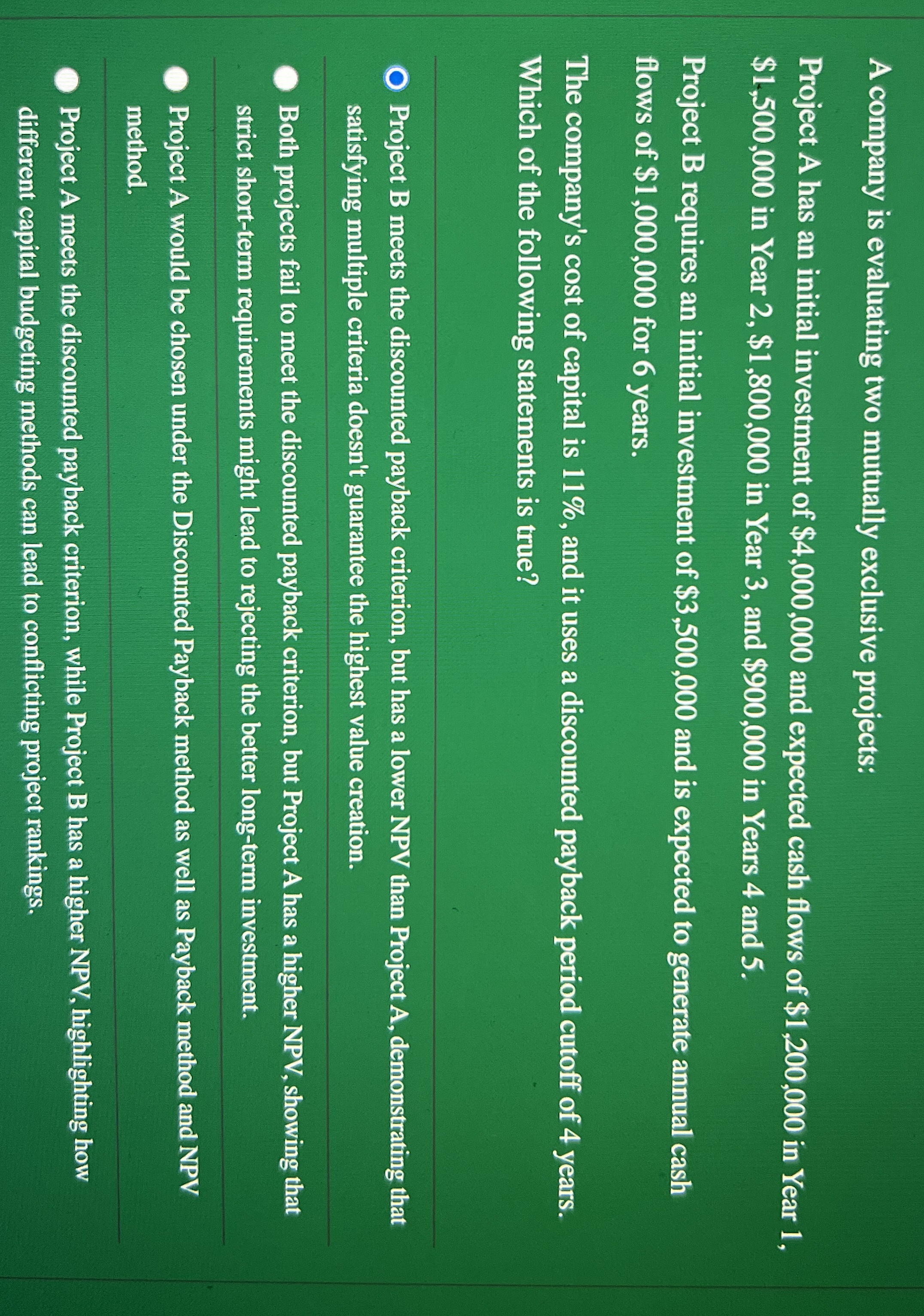
Question: A company is evaluating two mutually exclusive projects: Project A has an initial investment of $ 4 , 0 0 0 , 0 0 0
A company is evaluating two mutually exclusive projects:
Project A has an initial investment of $ and expected cash flows of $ in Year
$ in Year $ in Year and $ in Years and
Project B requires an initial investment of $ and is expected to generate annual cash
flows of $ for years.
The company's cost of capital is and it uses a discounted payback period cutoff of years.
Which of the following statements is true?
Project B meets the discounted payback criterion, but has a lower NPV than Project A demonstrating that
satisfying multiple criteria doesn't guarantee the highest value creation.
Both projects fail to meet the discounted payback criterion, but Project A has a higher NPV showing that
strict shortterm requirements might lead to rejecting the better longterm investment.
Project A would be chosen under the Discounted Payback method as well as Payback method and NPV
method.
Project A meets the discounted payback criterion, while Project B has a higher NPV highlighting how
different capital budgeting methods can lead to conflicting project rankings.
Step by Step Solution
There are 3 Steps involved in it
1 Expert Approved Answer
Step: 1 Unlock

Question Has Been Solved by an Expert!
Get step-by-step solutions from verified subject matter experts
Step: 2 Unlock
Step: 3 Unlock
 Study Help