







Question: (a) Consider the table given next, which tracks several performance indicators for Intel desktop processors since 2010. The Tech column shows the minimum feature
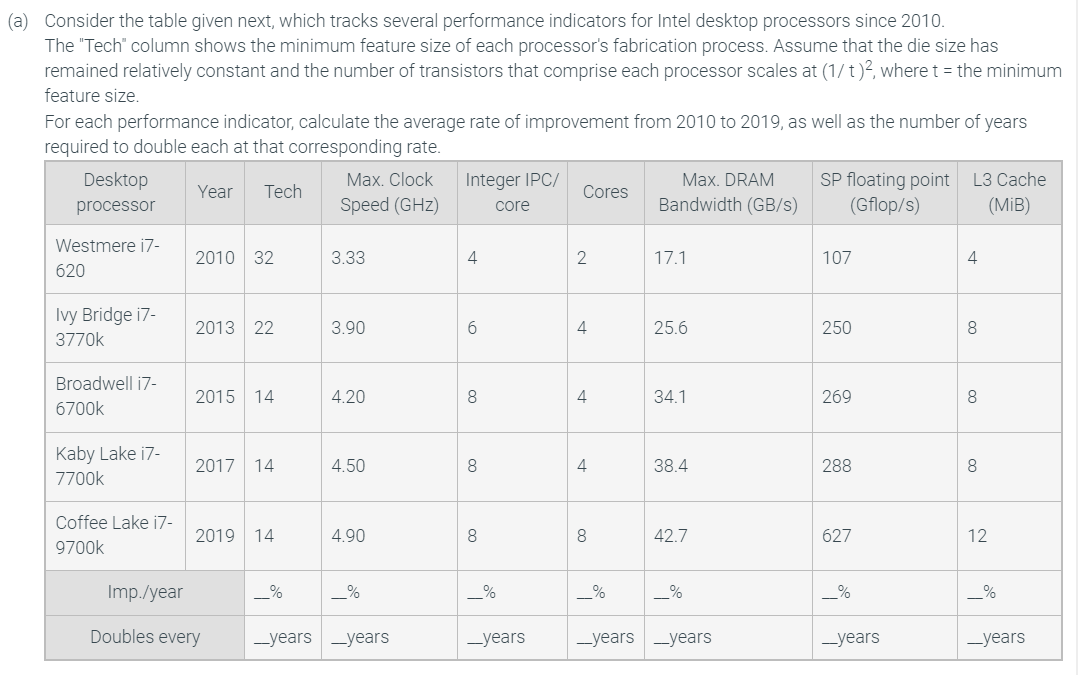
(a) Consider the table given next, which tracks several performance indicators for Intel desktop processors since 2010. The "Tech" column shows the minimum feature size of each processor's fabrication process. Assume that the die size has remained relatively constant and the number of transistors that comprise each processor scales at (1/t), where t = the minimum feature size. For each performance indicator, calculate the average rate of improvement from 2010 to 2019, as well as the number of years required to double each at that corresponding rate. Desktop processor Year Tech Max. Clock Speed (GHz) Integer IPC/ Cores core Max. DRAM Bandwidth (GB/s) SP floating point L3 Cache. (Gflop/s) (MiB) Westmere i7- 2010 32 3.33 4 2 17.1 107 4 620 Ivy Bridge i7- 2013 22 3.90 10 3770k 6 4 25.6 250 8 Broadwell i7- 2015 14 4.20 8 4 34.1 269 8 6700k Kaby Lake i7- 2017 14 4.50 8 4 38.4 288 8 7700k Coffee Lake i7- 2019 14 4.90 8 8 42.7 627 12 9700k Imp./year _% _% _% % % _% _% Doubles every _ years _ years _years _years _years _years _years
Step by Step Solution
There are 3 Steps involved in it

Get step-by-step solutions from verified subject matter experts
 Study Help