







Question: A cylinder is oriented vertically. A massless, frictionless piston inside the cylinder sits atop two stops that prevent it from moving any further down
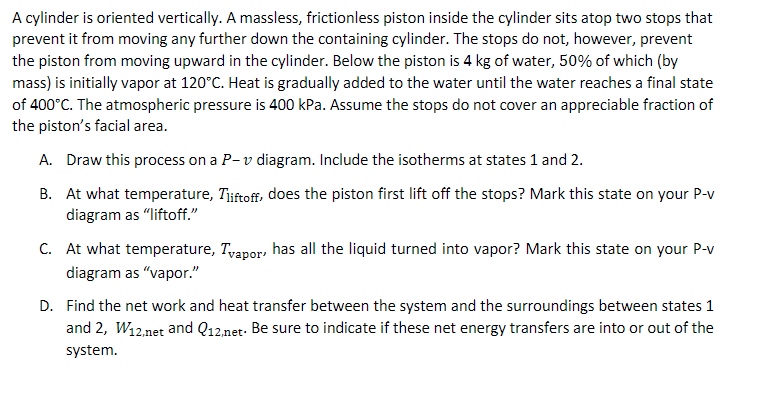
A cylinder is oriented vertically. A massless, frictionless piston inside the cylinder sits atop two stops that prevent it from moving any further down the containing cylinder. The stops do not, however, prevent the piston from moving upward in the cylinder. Below the piston is 4 kg of water, 50% of which (by mass) is initially vapor at 120C. Heat is gradually added to the water until the water reaches a final state of 400C. The atmospheric pressure is 400 kPa. Assume the stops do not cover an appreciable fraction of the piston's facial area. A. Draw this process on a P-v diagram. Include the isotherms at states 1 and 2. B. At what temperature, Tliftoff, does the piston first lift off the stops? Mark this state on your P-v diagram as "liftoff." C. At what temperature, Tvapor, has all the liquid turned into vapor? Mark this state on your P-v diagram as "vapor." D. Find the net work and heat transfer between the system and the surroundings between states 1 and 2, W12.net and Q12,net. Be sure to indicate if these net energy transfers are into or out of the system.
Step by Step Solution
There are 3 Steps involved in it

Get step-by-step solutions from verified subject matter experts
 Study Help