







Question: a. Derive the equation 2 for the species A diffusing through stagnant B and then integrate it to obtain the Equation 3. b. Derive the
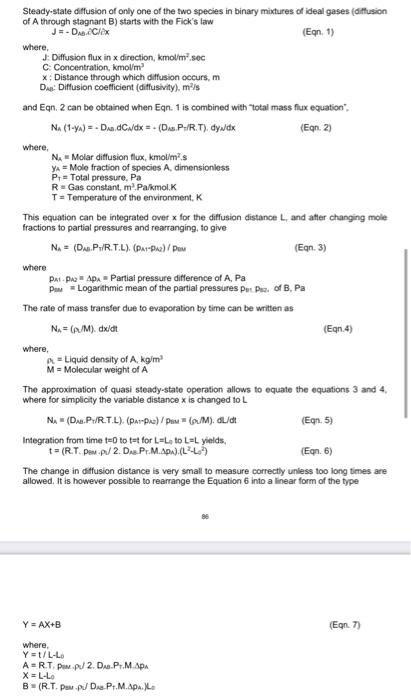
Steady-state diffusion of only one of the two species in binary mixtures of ideal gases (diffusion of A through stagnant B) starts with the Fick's law J.Da Clex (Egn. 1) where, Diffusion flux in x direction, kmolm.sec C Concentration, mom x: Distance through which diffusion occurs, m Dw: Diffusion coefficient (diffusivity), mils and Eqn, 2 can be obtained when Egn. 1 is combined with total mass flux equation", Na (T-ya) -- Dao.cCw/dx = - (D.P.R.T). dywdx (Egn. 2) where, Ni Molar diffusion flux, kmol/m's YA = Mole fraction of species A dimensionless P1 = Total pressure. Pa R=Gas constant, m.Palkmol.K T = Temperature of the environment, K This equation can be integrated over x for the diffusion distance L, and after changing mole fractions to partial pressures and rearranging, to give NA = (D.P.R.T.L). (PAT-Dua) Dom (Egn. 3) where Papa Apa Partial pressure difference of A, Pa Pu Logarithmic mean of the partial pressures Pot P. of B. Pa The rate of mass transfer due to evaporation by time can be written as NA = (_/M). dxidt (Egn.4) where, P = Liquid density of A, kom M = Molecular weight of A The approximation of quasi steady-state operation allows to equate the equations 3 and 4 where for simplicity the variable distance x is changed to NA - (D.PR.T.L). (PAD) Pas (w/M). Cl/dt (Egn. 5) Integration from time to to tet for LEL, to LeL yields t = (R.T. pen./2. Di.Pr.M.Ada).(L2L (Egn. 6) The change in diffusion distance is very small to measure correctly unless too long times are allowed. It is however possible to rearrange the Equation 6 into a linear form of the type Y = AX+B (Egn. 7) where Y=t/L-Le ART. P. 2. D.P.M.Apa X = L.L. B - (R.T. Pop Die Pt.M.ADA
Step by Step Solution
There are 3 Steps involved in it

Get step-by-step solutions from verified subject matter experts
 Study Help