







Question: (A) Determine a tight worst-case runtime bound for the function. Explain your reasoning and describe a scenario in which this worst-case is achieved. (B) Do
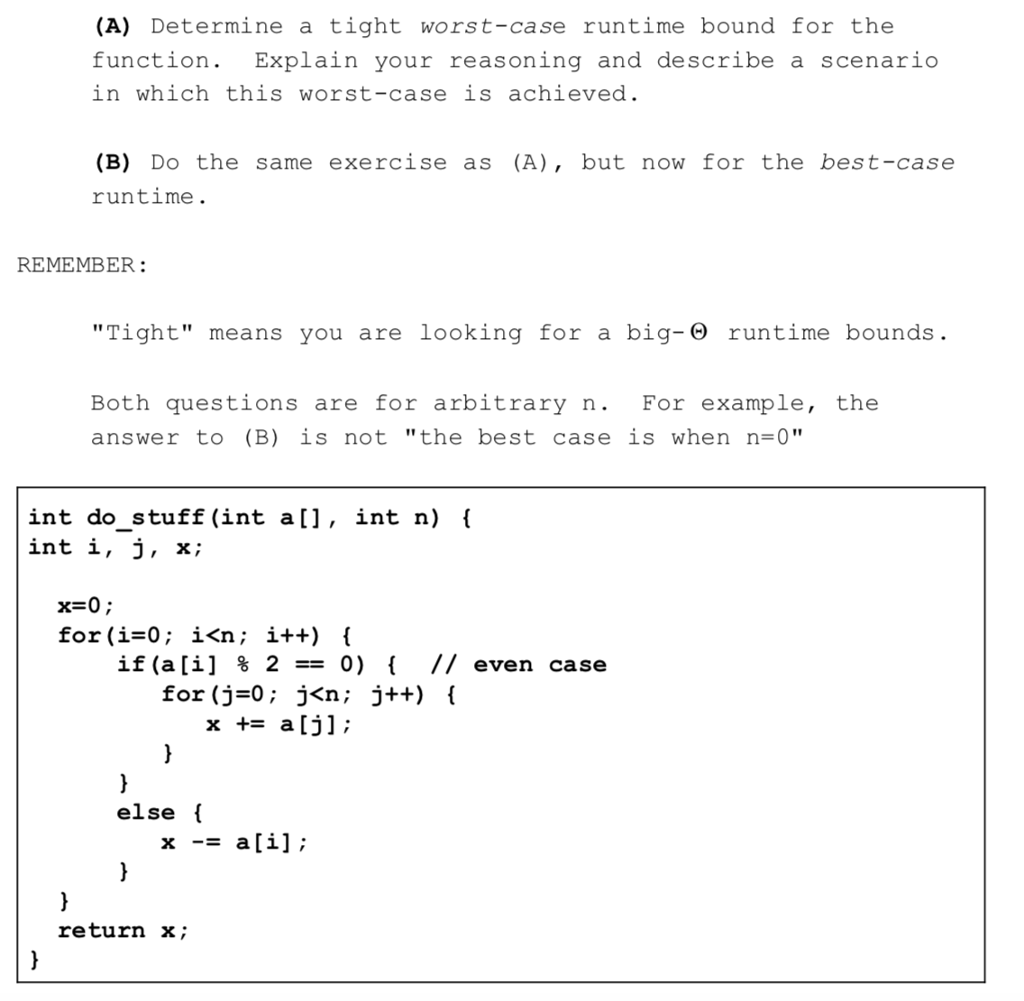
(A) Determine a tight worst-case runtime bound for the function. Explain your reasoning and describe a scenario in which this worst-case is achieved. (B) Do the same exercise as (A), but now for the best-case runtime. REMEMBER "Tight" means you are looking for a big- runtime bounds. Both questions are for arbitraryn. For example, the answe r to (B) Is not "the best case is when n=0" int do stuff (int a [], int n) t int i, j, x; x=0 ; for (i-0; i
Step by Step Solution
There are 3 Steps involved in it
1 Expert Approved Answer
Step: 1 Unlock

Question Has Been Solved by an Expert!
Get step-by-step solutions from verified subject matter experts
Step: 2 Unlock
Step: 3 Unlock
 Study Help