







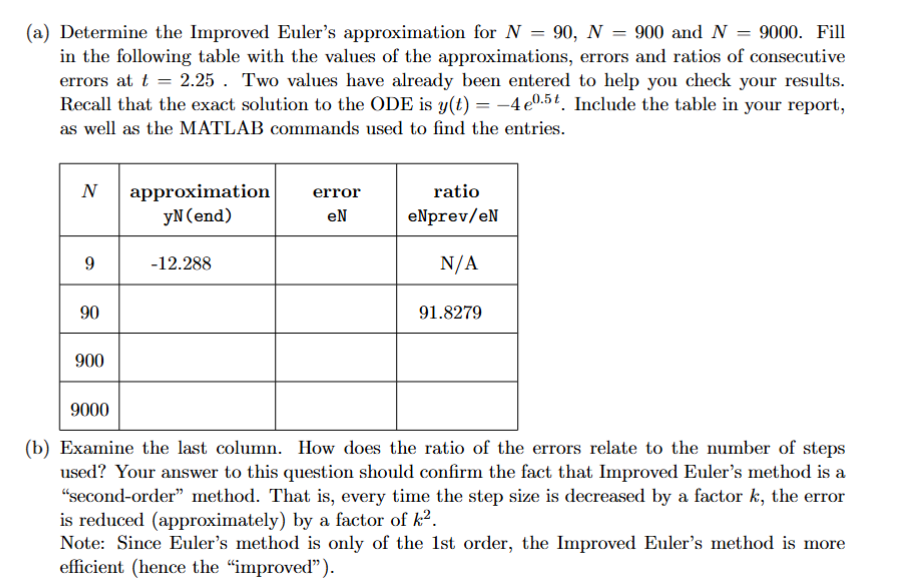
Question: ( a ) Determine the Improved Euler's approximation for ( N = 9 0 , N = 9 0 0 ) and
a Determine the Improved Euler's approximation for N N and N Fill in the following table with the values of the approximations, errors and ratios of consecutive errors at t Two values have already been entered to help you check your results. Recall that the exact solution to the ODE is yt e t Include the table in your report, as well as the MATLAB commands used to find the entries.
b Examine the last column. How does the ratio of the errors relate to the number of steps used? Your answer to this question should confirm the fact that Improved Euler's method is a "secondorder" method. That is every time the step size is decreased by a factor k the error is reduced approximately by a factor of k
Note: Since Euler's method is only of the st order, the Improved Euler's method is more efficient hence the "improved"
Step by Step Solution
There are 3 Steps involved in it
1 Expert Approved Answer
Step: 1 Unlock

Question Has Been Solved by an Expert!
Get step-by-step solutions from verified subject matter experts
Step: 2 Unlock
Step: 3 Unlock
 Study Help