







Question: A discount function is defined as follows:-(t)=1/(1 + .016), where t > 0. A five-year annuity has payments of 1 times, t 1.2.3. 4. and
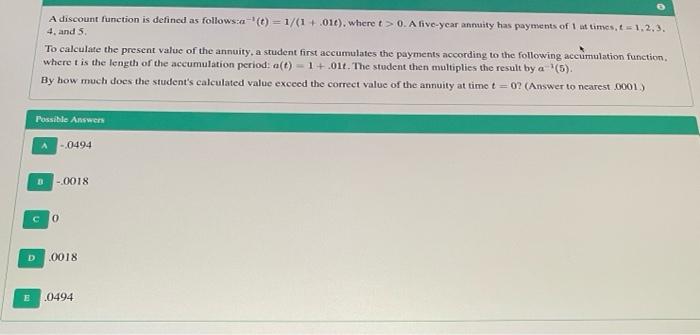
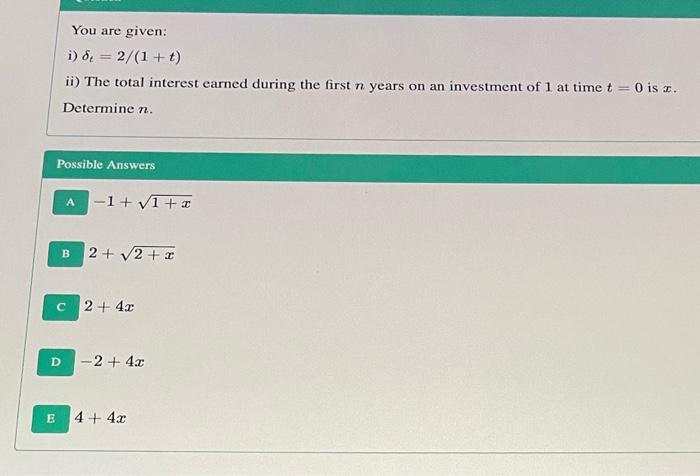
A discount function is defined as follows:-(t)=1/(1 + .016), where t > 0. A five-year annuity has payments of 1 times, t 1.2.3. 4. and 5 To calculate the present value of the annuity, a student first accumulates the payments according to the following accumulation function, where is the length of the accumulation period: a() - 1+.01. The student then multiplies the result by a (5) By how much does the student's calculated value exceed the correct value of the annuity at time t = 0? (Answer to nearest .0001) Possible Answers - 0494 -.0018 0 _0018 .0494 You are given: i) 8 = 2/(1+t) ii) The total interest earned during the first n years on an investment of 1 at time t = 0 is B. Determine n. Possible Answers -1++ B B 2+2+ 2 + 4.2 D-2 + 4.C E 4+ 4.2
Step by Step Solution
There are 3 Steps involved in it

Get step-by-step solutions from verified subject matter experts
 Study Help