







Question: a) Discuss whether the system should be controllable or not. Check your intuition by forming the controllability matrix and checking its rank. b) Assume
![[0 1 01x1 0 0 1 2 + J o -6 = Lo y = [1 o x3 + [191 u 0 0] X X3.](https://dsd5zvtm8ll6.cloudfront.net/questions/2024/01/6598310ad296a_1704472842274.jpg)
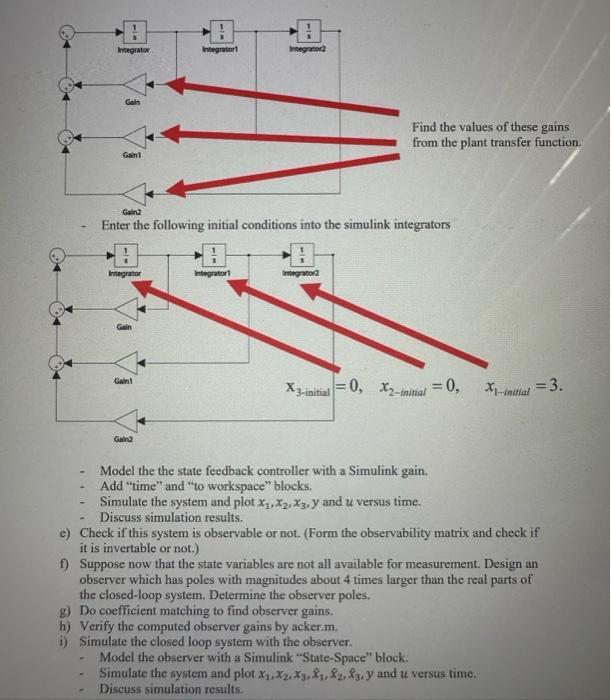
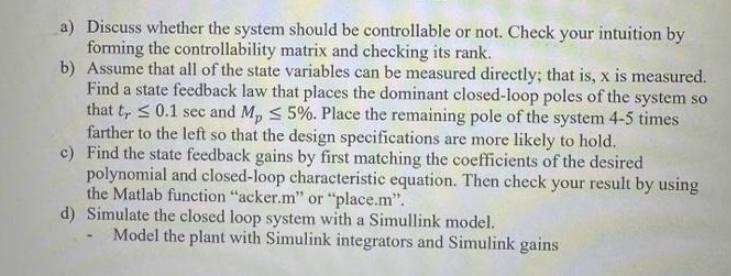
a) Discuss whether the system should be controllable or not. Check your intuition by forming the controllability matrix and checking its rank. b) Assume that all of the state variables can be measured directly; that is, x is measured. Find a state feedback law that places the dominant closed-loop poles of the system so that t 0.1 sec and M 5%. Place the remaining pole of the system 4-5 times farther to the left so that the design specifications are more likely to hold. c) Find the state feedback gains by first matching the coefficients of the desired polynomial and closed-loop characteristic equation. Then check your result by using the Matlab function "acker.m" or "place.m". d) Simulate the closed loop system with a Simullink model. Model the plant with Simulink integrators and Simulink gains [0 1 01x1 0 0 1 2 + J o -6 = Lo y = [1 o x3 + [191 u 0 0] X X3. Integrator Gain Gain1 1 Integrator Gain Gain2 Enter the following initial conditions into the simulink integrators Gain! Integrator Gain2 Integrator2 Integrator Integrator2 Find the values of these gains from the plant transfer function. X 3-initial = 0, X2-initial = 0, Model the the state feedback controller with a Simulink gain. Add "time" and "to workspace" blocks. Simulate the system and plot x, x, X3,y and u versus time. Discuss simulation results. Model the observer with a Simulink "State-Space" block. e) Check if this system is observable or not. (Form the observability matrix and check if it is invertable or not.) f) Suppose now that the state variables are not all available for measurement. Design an observer which has poles with magnitudes about 4 times larger than the real parts of the closed-loop system. Determine the observer poles. g) Do coefficient matching to find observer gains. h) Verify the computed observer gains by acker.m. i) Simulate the closed loop system with the observer. X1-initial = 3. Simulate the system and plot x, x2. x3. , 22, 23, y and u versus time. Discuss simulation results.
Step by Step Solution
3.56 Rating (153 Votes )
There are 3 Steps involved in it
Solutions Step 1 To solve the questions given we need to follow the below steps a Step 1 Controllability Analysis The system consists of three linear differential equations representing the state vari... View full answer

Get step-by-step solutions from verified subject matter experts
 Study Help