







Question: a Exercise E4.13 Data estimation. The modulus E is approximately proportional to the melt- ing point Tm in Kelvin (because strong inter-atomic bonds give both
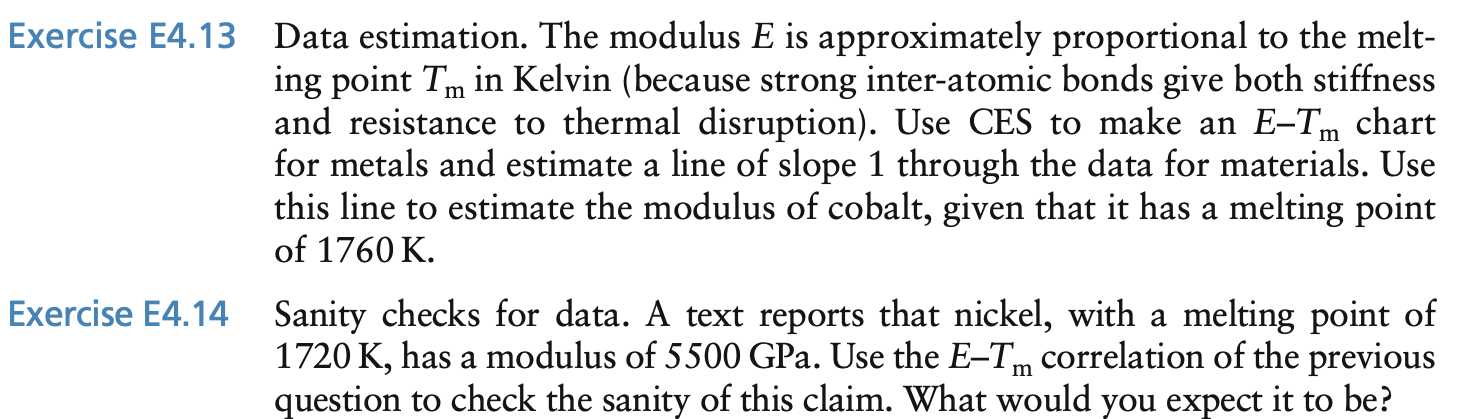
a Exercise E4.13 Data estimation. The modulus E is approximately proportional to the melt- ing point Tm in Kelvin (because strong inter-atomic bonds give both stiffness and resistance to thermal disruption). Use CES to make an E-Tm chart for metals and estimate a line of slope 1 through the data for materials. Use this line to estimate the modulus of cobalt, given that it has a melting point of 1760 K. Exercise E4.14 Sanity checks for data. A text reports that nickel, with a melting point of 1720 K, has a modulus of 5500 GPa. Use the E-Tm correlation of the previous question to check the sanity of this claim. What would you expect it to be? a a Exercise E4.13 Data estimation. The modulus E is approximately proportional to the melt- ing point Tm in Kelvin (because strong inter-atomic bonds give both stiffness and resistance to thermal disruption). Use CES to make an E-Tm chart for metals and estimate a line of slope 1 through the data for materials. Use this line to estimate the modulus of cobalt, given that it has a melting point of 1760 K. Exercise E4.14 Sanity checks for data. A text reports that nickel, with a melting point of 1720 K, has a modulus of 5500 GPa. Use the E-Tm correlation of the previous question to check the sanity of this claim. What would you expect it to be? a
Step by Step Solution
There are 3 Steps involved in it

Get step-by-step solutions from verified subject matter experts
 Study Help